Online Bingo in the UK: Rooms, Tickets and Slots
 Available in GB
Compare shared bingo draws and ticket patterns with separate casino games, and assess ticket prices, prizes and play limits.
- Bingo Rooms and Casino Games: Two Different Products
- Bingo Formats: Tickets, Patterns and Prizes
- Bingo Sites with Slots: Read the Offer as a Calculation
- Real-Money Bingo: Ticket Prices and Prize Scale
- Free Bingo Games and Tickets: The Conditions Still Count
- Online Bingo in 2026: What Has and Has Not Changed
- When Bingo Rooms Are Busiest
- Mobile Bingo and Slots: Keep Play Within a Set Limit
- Bingo Slot Machines: A Side Game, Not the Bingo Room
- Can an Online Bingo Site Also Offer Slot Games?
Bingo Rooms and Casino Games: Two Different Products
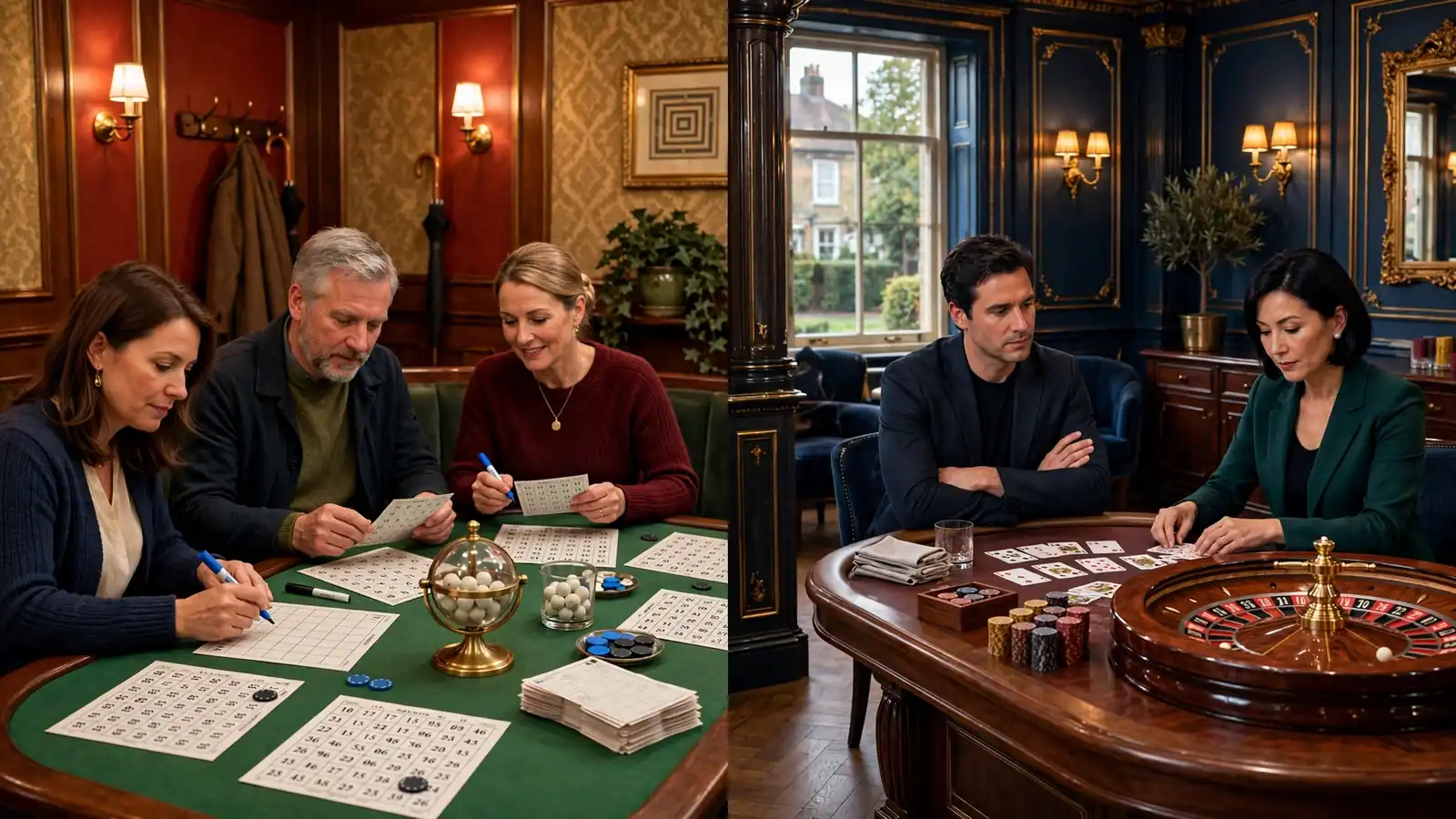
An online bingo room and a casino lobby can appear under the same account, but they do not describe the same game. Bingo is organised around tickets, a shared number draw and a pattern that determines whether a ticket wins. Casino games are separate products, each governed by its own rules. The presence of both on one site is a matter of how the operator groups its services, not evidence that the games work alike.
In a bingo room, players buy tickets for a game. Numbers are drawn, and a ticket’s result depends on whether it completes the required pattern before other players’ tickets do. The draw is shared: a number called in the room applies to the tickets in that game, rather than starting an isolated round for each player. That structure is the defining feature of online bingo, whether the room is accessed through a website or an online bingo casino app.
A casino game does not become bingo simply because it sits beside the bingo rooms. It follows the rules of that game, rather than relying on a shared bingo draw and ticket pattern. The distinction matters when comparing products: a bingo ticket participates in a particular room’s game, while a casino title has a separate way of determining its result. A common account or menu does not merge those rules.
Choosing an online bingo site in the UK is easier when you can check practical details before signing up. This list provides a concise reference for considering the options.
Payout speed: 1-3 business days Britsino lists a payout speed of 1–3 business days, a useful detail to consider when assessing an online bingo option.
Payout speed: 1-3 business days NightLuck lists a payout speed of 1–3 business days, giving readers a practical point to consider.
Payout speed: 1-3 business days Chanze lists a payout speed of 1–3 business days, which may help inform your choice of online bingo site.
Payout speed: 1-3 business days SpinFormula lists a payout speed of 1–3 business days, a relevant detail for readers weighing their options.
Payout speed: 1-3 business days Amunbet lists a payout speed of 1–3 business days, providing one practical detail to consider.
Payout speed: 1-3 business days Zombillion lists a payout speed of 1–3 business days, which readers can factor into their decision.
Payout speed: 1-3 business days WinBeast lists a payout speed of 1–3 business days, a useful point of reference when choosing an online bingo option.
Payout speed: 1-3 business days BeOnBet lists a payout speed of 1–3 business days, offering a practical detail for consideration.
Payout speed: 1-3 business days EvoSpin lists a payout speed of 1–3 business days, a detail readers may wish to take into account.
Payout speed: 1-3 business days Jetsetspins lists a payout speed of 1–3 business days, providing a practical point of reference.
The phrase “online casino bingo” can therefore refer to a site that offers both, rather than to one hybrid game. The same applies to a bingo game found in a casino lobby: its classification depends on how it is played, not on the label of the page hosting it. A room built around tickets and called numbers is bingo; a separate casino title remains a casino game, even when both are available through the same operator.
This separation also helps make sense of the phrase casino and bingo. A site may present both categories together, but each needs to be assessed on its own terms. The bingo side is organised around participation in a room and the progress of a draw. Casino products have their own rules and outcomes. A site’s shared branding or navigation is not a substitute for understanding which product is being entered.
The distinction has a regulatory side as well. Online bingo is legal in the United Kingdom within a heavily regulated market. An operator offering gambling services to UK players must hold the relevant, separate UK Gambling Commission licence; a licence for another activity should not be assumed to cover everything the operator offers. The UKGC’s requirements address fairness, anti-money laundering and responsible gambling. These are operating standards, not a description of how any particular bingo ticket or casino game works.

The licence applies to the operator’s legal provision of gambling, while the product rules explain what happens after a player joins a game. Those are different questions. A bingo room can be described accurately as a ticket-and-draw product, but that description does not establish whether its operator is authorised. Conversely, a UKGC licence does not make bingo and casino games interchangeable. Regulation and game mechanics should be checked separately.
A useful way to read an online bingo casino is to treat the bingo room and casino lobby as distinct sections of one service. The room’s rules explain how tickets take part in a draw and how a winning pattern is recognised. The rules for a casino game explain how that title reaches an outcome. The site’s overall presentation may make switching between them look seamless; the underlying products remain different.
The same principle applies when a site describes itself as an online bingo casino or promotes online bingo and casino play together. Those labels indicate a combined offer, not a single set of rules. The bingo component still depends on tickets and a room draw. Casino games still operate separately. Keeping that boundary clear prevents a misleading comparison between taking part in a shared bingo game and playing an individual casino title.
Before depositing, the operator’s UKGC licence number should be prominent in the footer and checked against the Commission’s public register. A missing or unclear licence number is not a minor presentation issue: the tab should be closed. UK regulation attaches to the operator serving the market, not to a game’s name, a familiar layout or the fact that bingo and casino products appear on the same website.
License Check
A missing or unclear UKGC licence number in the footer is not a minor issue; if the operator is not authorised, the tab should be closed immediately.
Bingo Formats: Tickets, Patterns and Prizes
A bingo format determines what appears on a ticket and what must be completed to win. The distinction is not cosmetic: the same draw can be judged against different ticket layouts and winning patterns. In online bingo, the format therefore needs to be clear before play begins. A familiar word such as “line” has a specific role in one format, while another may define a win by a shape across the card.
90-ball bingo: lines and full house
The 90-ball ticket has a 9×3 layout. Its prize structure progresses through one line, two lines and a full house. That gives the game a sequence of defined milestones: completing a single line is distinct from completing two, and both are separate from filling the ticket for a full house.
This structure makes the winning condition comparatively direct to read. The ticket is arranged in rows, and the prizes are tied to the completion of lines and then the whole ticket. A player assessing a 90-ball room can focus on those stated stages rather than looking for a shape that might cross rows or columns.
The full house is the final ticket-completion condition in this format. It is not interchangeable with the earlier line prizes: each describes a different point at which a winning condition is met. The room’s rules should make clear how each prize stage is treated, so the ticket and prize description can be read together.


80-ball bingo: coloured patterns
An 80-ball ticket uses an 8×4 grid. Its winning conditions can be based on coloured patterns, including four corners, a letter shape or a full card. Unlike the line-based progression associated with 90-ball bingo, the defining feature here is the pattern selected for the game.
That changes how a ticket is read. Four corners asks for a particular arrangement on the grid; a letter shape asks for a different arrangement; a full card refers to completing the ticket. The exact pattern matters because a marked ticket does not qualify merely by having the same number of completed spaces as another player’s ticket. The required arrangement is part of the rule.
A pattern’s visual simplicity does not make it equivalent to a line prize. The grid supplies the positions, and the named pattern supplies the condition for a win. Before a round, the useful detail is the pattern in force, not just the label “80-ball”. A room that offers several pattern options may change what counts as a completed ticket from one game to another.
75-ball bingo: a named shape decides the win
The 75-ball ticket is arranged as a 5×5 grid. Wins depend on completing a specified pattern, such as a cross, an X, a diamond, the letter T or a picture frame. The pattern is the organising rule: the same ticket layout can support different winning conditions depending on which shape the game calls for.
In 75-ball bingo, a specified pattern (such as a cross, X, diamond, letter T, or picture frame) is the organising rule that determines the win.
This makes the stated pattern central to understanding the round. A cross and an X are not two descriptions of the same arrangement, and a diamond or picture frame has its own outline. The relevant question is whether the marked positions match the chosen pattern, not whether a row has been completed as in the line-based prize stages of 90-ball bingo.
The range of possible shapes also means that “75-ball” alone does not fully describe the winning condition. The grid identifies the ticket format; the game’s pattern identifies what must be completed. Both pieces are needed to understand how a win is determined.
Comparing the rules, not just the labels
The practical distinction can be reduced to ticket structure and the condition attached to it:
| Format | Ticket layout | Winning condition |
|---|---|---|
| 90-ball | 9×3 | One line, two lines or a full house |
| 80-ball | 8×4 | A coloured pattern, such as four corners, a letter shape or a full card |
| 75-ball | 5×5 | A specified pattern, such as a cross, X, diamond, letter T or picture frame |
These formats should not be treated as interchangeable versions of one rule set. In 90-ball bingo, the listed prizes follow line completion and then a full house. In 80-ball bingo, the room may define the win through coloured shapes. In 75-ball bingo, the selected design on the grid determines the target.
The format name is a starting point, not a substitute for the rules displayed for the game. The ticket layout tells how the card is organised; the prize condition tells what must be completed. Reading both avoids a basic but costly misunderstanding: recognising the game type while overlooking the pattern or stage that actually qualifies for a prize.
Bingo Sites with Slots: Read the Offer as a Calculation
A combined bingo-and-slots offer is not one pot of unrestricted money. It is a set of conditions attached to a deposit, a bonus and sometimes free tickets. The headline value describes what may be credited; the wagering requirement determines how much eligible play must take place before any bonus-related balance can be withdrawn.
A specialist review gives one example of a new-player package: a £10 cash bonus alongside 30 free bingo tickets. That is a reported offer, not a standard entitlement across UK bingo sites with slots. The cash bonus and tickets may have separate terms, so the package should be split into its components before its value is assessed. The terms need to show what triggers the bonus, which games count towards wagering, whether the deposit itself is included in the calculation and when the offer expires.
The wagering base changes the result
A specialist review reports deposit-based bingo offers with wagering requirements ranging from 20x to 65x. Some apply the multiplier only to bonus funds. That distinction matters more than the headline multiplier: the same number can produce a different turnover obligation depending on the amount to which it is applied.
For instance, a £10 bonus subject to a stated multiplier cannot be evaluated from the multiplier alone. The terms must identify the wagering base and which play qualifies. If wagering applies only to bonus funds, the deposit is not automatically part of that base; if the offer defines a different base, the calculation changes accordingly. No amount of attractive packaging resolves an unclear formula.
The word “wagering” also does not mean that the required play will return the bonus intact. It is a turnover condition, not a promise of a particular balance at the end. The practical figure to establish is the eligible spending required, followed by the amount that remains withdrawable once the requirement is met. If bingo and slot play count differently, that allocation belongs in the terms as well.
- Identify the wagering base
- Check the list of qualifying games
- Note the exact expiry deadline
- Rely on the headline bonus value
- Assume the multiplier applies only to bonus funds
- Ignore the wagering window
Put the deadline beside the multiplier
A specialist review describes a 30-day wagering window, with the countdown beginning when the bonus is credited. The clock therefore starts at receipt, not when the first game is played. A bonus left untouched can still lose time.
The deadline and the multiplier should be read together. A requirement that looks manageable in isolation may be less useful if eligible play has to be completed within a fixed window. The offer terms should state when the bonus lands, when the wagering period ends and what happens to any balance if the requirement is incomplete. The starting point is a condition, not a small-print detail.
For a cash bonus and free-ticket package, it is also necessary to check whether ticket winnings are folded into the cash-bonus wagering or governed separately. Treating the whole package as cash can overstate its value. The relevant comparison is between the amount credited, the eligible play required, the expiry date and the amount that can actually be withdrawn after the conditions are satisfied.
The useful comparison between new bingo sites with slots is therefore not the largest headline bonus. It is the offer with terms that make the calculation legible: a defined wagering base, a clear list of qualifying games, a stated deadline and an explicit treatment of winnings. If one of those inputs is missing, the apparent value cannot yet be calculated.
Real-Money Bingo: Ticket Prices and Prize Scale
The price of an online bingo ticket can be as low as 1p in a low-stakes room, with some tickets costing 5p. At the premium end, a game may charge £1 or more per ticket. That range changes the amount committed to a game; it does not, by itself, establish what any ticket will return. The prize depends on the particular room and game.
A useful comparison needs both sides of the transaction: the ticket cost and the stated prize. A low price can make a room accessible at a modest spend, but the cash prize may also be small. A more expensive ticket means more money is at stake for each entry. A larger advertised prize can change the scale of a possible win, but it is not a measure of the value of an individual ticket.
A specialist affiliate review has described a 1p game with a £10 full-house prize and a £1 game with a jackpot in the hundreds or thousands. Those are examples reported by that review, not a general price list or a reliable promise about every room. Prize pools and game terms can vary, so the figures need to be read as a comparison of possible scales rather than as a market standard.
The distinction matters when comparing rooms. A ticket priced at 1p and one priced at £1 are separated by a substantial difference in cost per entry. The higher-priced game may advertise a much larger jackpot, but the headline amount does not show how many tickets are being bought, how the prize is allocated, or what the chances of winning are. Those details belong to the specific game’s published terms. A prize figure without its conditions is only half a calculation.
Attention: A larger advertised prize does not establish the value of an individual ticket, nor does it show the chances of winning.
Ticket limits also affect the total spend. A room may restrict how many tickets can be purchased for a game, and the limit can depend on ticket price. Where several tickets are bought, the relevant cost is the ticket price multiplied by the number entered. This is a straightforward way to compare the amount committed across games without treating a larger prize display as proof of better value. The ticket price is fixed at purchase; a prize is conditional on the draw and the outcome.
Real-money bingo is not the same as an offer that adds bonus funds or free play. A cash ticket is an amount paid to enter a room game, while any promotional balance has its own terms. Keeping those categories separate prevents a bonus headline from being mistaken for the prize available in the game itself. For a price comparison, the central figures are the cost of entry and the prize stated for that game.
For recreational players in the United Kingdom, bingo winnings are not taxable. That does not change the cost of a ticket or enlarge the prize; it simply means a recreational player does not pay income tax on those winnings. The practical comparison remains the amount spent on tickets against the prize structure offered by the room. A low entry price can still be a real-money stake, and a high jackpot remains a potential outcome rather than an expected return.
Free Bingo Games and Tickets: The Conditions Still Count
A free bingo ticket removes the ticket price, not necessarily every condition attached to play. Its value depends on where it can be used, when it expires and what happens to any winnings. Those terms determine whether the ticket is usable and whether a resulting balance can be withdrawn.
Free tickets may be limited to named rooms or particular ball types. A ticket issued for one room may not work in another, even if both are available from the same account. The restriction matters because the ticket is not general-purpose credit: it is permission to enter a specified game under stated conditions. A specialist review has reported offers with room or ball-type restrictions and expiry after 24 hours. That is an example of a reported offer, not a universal deadline; the account’s own promotion terms set the actual window.
Expiry can make a ticket worth nothing if it is not used in time. The relevant detail is the deadline attached to that specific award, including when the clock starts. A ticket may be credited before the intended game, so checking the expiry in the promotion details or account history is more useful than relying on the date an offer was first seen.
The larger financial condition concerns winnings. Free tickets cannot be withdrawn as tickets or converted directly into cash for withdrawal. Any winnings are credited as cash, but that does not necessarily make them immediately withdrawable. They may carry a wagering requirement, including the same requirement applied to a deposit bonus. In other words, the prize can appear in the balance while still being subject to a further play-through condition.
A specialist review has reported wagering requirements from 20x to 65x on winnings from free tickets. Those figures describe the reviewed terms, not a fixed rule across bingo sites. The promotion’s own terms need to state whether the requirement applies to the winnings, another bonus amount, or both. The calculation base changes the amount of eligible play required, so a multiplier without its base is incomplete information.
Free Ticket Conditions
Free tickets may have room or ball-type restrictions and can expire quickly (e.g., after 24 hours). Additionally, winnings from free tickets may be subject to wagering requirements ranging from 20x to 65x before they can be withdrawn.
The practical comparison is between the ticket’s face value and the conditions on the resulting cash. A free entry with restrictive room access and a short expiry may have limited use; a prize subject to a wagering requirement may remain unavailable for withdrawal until the stated play condition is met. Neither the word “free” nor a cash balance establishes that funds are ready to withdraw.
Free bingo tickets are also distinct from free online bingo slot games. A ticket grants entry to a bingo room; it does not, by itself, provide a slot game or remove conditions attached to a separate casino promotion. Each offer should be assessed on its own terms: eligible room, eligible ball type, expiry, and the treatment of winnings.
Online Bingo in 2026: What Has and Has Not Changed
The year in a page title does not, by itself, make online bingo a new game. Its central sequence remains familiar: a player buys a ticket, numbers are drawn, and a win depends on completing the required pattern before other players do. The screen carries the draw, but the outcome still turns on the ticket and the pattern.
That continuity matters more than a new label. A room may present its games differently, but the basic transaction is still a ticket entered into a draw. The pattern sets the condition for a win; the draw supplies the numbers against which that condition is tested. A digital setting changes where the game is played, not what makes a bingo ticket successful.

Established formats remain a useful way to understand the product. In 90-ball bingo, the draw is tied to a ticket and its winning pattern. In 80-ball bingo, the ticket uses a 4×4 grid, and rounds are quicker than in 90-ball bingo. That difference affects the pace of play, but it does not replace the shared structure of buying a ticket, following a draw and waiting for a pattern to be completed. The formats are variations within bingo, not evidence that the underlying product has been reinvented.
The distinction between a format and a change to the whole game is straightforward. A different grid or a quicker round changes the way a particular game proceeds. It does not alter the core relationship between ticket, drawn numbers and pattern. A date such as 2026 cannot establish a new rule or format on its own; the practical details of a room’s game remain the relevant information.

This is also why descriptions of online bingo should be read literally. The defining activity is participation in a bingo draw, not simply the presence of bingo-themed graphics or other games on the same site. For the core product, the question remains whether a ticket is entered, numbers are drawn and a winning pattern is completed ahead of other players.
So, what has changed is not something that can be inferred from the calendar alone. What has not changed is the underlying structure that makes the game bingo. The pace may differ between formats, as it does between 80-ball and 90-ball play, while the basic ticket-and-draw experience stays intact.
When Bingo Rooms Are Busiest
A specialist review places the busiest period for online bingo rooms between 7pm and 11pm, with operators scheduling their largest prize pools during those hours. That is a reported pattern, not a fixed timetable for every room. The practical point is that evening activity and headline prizes may coincide, so the published room schedule matters more than a general assumption about when a game will be busiest.
Online bingo rooms are typically busiest between 7pm and 11pm, which is when operators often schedule their largest prize pools.
Traffic and prize scheduling are related but not identical. A room can attract more players during a peak period, while the prize attached to a particular game depends on the operator’s schedule. The larger pool is therefore a feature of selected games, not a promise that every evening session carries the same prize. Checking the listed game time and prize before joining gives a clearer view of what is actually on offer.
For people deciding when to play bingo, the evening window provides a useful starting point for finding busier rooms and scheduled larger pools. It does not establish that every room is active throughout the whole period. Nor does a busier room change the rules printed for its game: the ticket and the stated winning condition still determine how a result is settled. Timing helps identify when a larger scheduled prize may be available; it does not improve the value of a ticket by itself.
The distinction matters where several rooms are listed together. A prominent prize can draw attention, but its scheduled start time and the room’s current activity are separate details. Treating the headline amount as the whole offer leaves out the timetable that determines whether the game is running and the conditions attached to participation. Evening availability is a scheduling clue, not a substitute for the game listing.

The reported peak is narrow enough to be useful for planning, but it should not be read as a guarantee about a particular operator or session. Room schedules can be checked directly, and the relevant comparison is between the listed start time, the stated prize pool and the ticket terms for that game. That keeps the decision tied to the session itself rather than to a broad claim about evening bingo.
Mobile Bingo and Slots: Keep Play Within a Set Limit
A phone makes bingo rooms and slot games available in the same account, but it does not make their spending interchangeable. Deposits fund the account; tickets and spins then draw on that balance. Without a set boundary, a series of small payments can add up to more than the amount intended for play.
UK-licensed remote operators must prompt new customers to set a financial limit before their first deposit and provide accessible account-level controls. A specialist review also describes deposit limits set by day, week or month as an option at most operators. The available periods and the way a limit works depend on the operator, so the account terms matter: a deposit cap controls money entering the account, not necessarily how quickly the balance is spent.
For mobile bingo and slot play, a useful limit starts with the total amount allocated to gambling, rather than a separate figure for each game. Splitting one budget between bingo tickets and slots can otherwise make each category appear affordable while the combined spend exceeds the intended amount. The limit should be set before play and kept at a level that does not depend on winnings to replenish it.
Financial Limit Setup
- Allocate a total gambling budget
- Set a deposit limit (daily, weekly, or monthly)
- Verify identity and age (18+)
- Confirm the payment method is not a credit card
A deposit limit is a control, not a forecast of likely losses or a promise that funds will last for a particular period. It also does not change the rules of a game. Where a limit is reached, the account control should take precedence over the temptation to keep playing; raising it to recover losses defeats the purpose of setting it.
Payment choice is another part of the boundary. Credit card gambling is banned in the UK, including credit-card funds routed through a money service business or a wallet that permits such funds to be used for gambling. A UK-licensed operator must verify identity, and age must be checked before deposits are allowed. Gambling is for people aged 18 and over.
Mobile access changes where play happens, not the arithmetic. A limit recorded at account level gives bingo and slots one shared financial boundary, rather than leaving each session to set its own.

Bingo Slot Machines: A Side Game, Not the Bingo Room
A bingo slot machine is a slot-style game, not a faster version of a bingo room. In bingo, players hold tickets while numbers are drawn, and a win depends on completing the relevant pattern. A slot game instead produces its own play outcome; the ticket, draw and shared-room result are not part of that process.
The distinction matters when comparing returns. Return to player (RTP) is a game’s stated theoretical return across play, not a promise about what an individual session will pay. Side games often have lower RTP percentages than the bingo room itself. That comparison does not mean every ticket produces a better result than every slot spin: RTP describes the game over time, while a particular result can differ sharply.
The practical calculation is therefore separate for each product. Bingo ticket spending belongs to the room game. Slot play has its own stake and outcome, and its RTP should be read as a separate measure rather than folded into the bingo prize pool. A slot result does not complete a bingo pattern, and a bingo win does not establish what a slot game will return.

The label “bingo slot” can blur that boundary, but it does not change the mechanics. The game remains a slot-style side activity, with a separate return profile. Treating the two products as interchangeable makes the comparison less useful: the room’s draw-based prizes and the slot’s theoretical RTP answer different questions. For a UK player, real-money slot play also sits within the UKGC-licensed gambling framework; the product name does not create an exception.
Can an Online Bingo Site Also Offer Slot Games?
Yes. Some online bingo rooms also provide access to slot games, and a specialist review describes an offer in which each bingo ticket purchased comes with a free slot spin. That is a link between two products, not a change to the bingo game: the ticket enters a bingo draw, while the spin is played on a slot game.
The distinction matters when checking what a ticket purchase buys. A ticket remains the entry to the room’s bingo game; the attached spin is a separate feature with its own game rules. It does not add numbers to the ticket or alter the pattern needed to win bingo. Nor should the wording “free spin” be read as a guaranteed cash return. The stated benefit is a chance to play a slot game, not a promised prize.

Availability and terms depend on the particular room and offer. The conditions should identify which ticket purchases qualify, which slot the spin applies to, and whether any winnings from it carry restrictions. Those details determine the actual value; the label alone does not.
For UK players, the operator must hold a current UKGC licence to offer online gambling legally. A bingo site’s inclusion of slot games does not change that requirement. Slot play remains subject to the rules applying to online slots, and it should be assessed separately from the cost and outcome of a bingo ticket.
So an online bingo site can offer slot games, including a spin linked to a ticket purchase. The slot feature is an add-on, not part of the bingo draw, and its terms—not the promotional wording—show what the offer provides.
How long do online casino withdrawals take in the UK?
E-wallet withdrawals typically take up to 24 hours to process after the operator releases the funds. Credit cards cannot be used for gambling in Great Britain, so withdrawals or deposits should use a debit card or another available method.
Are the promoted bingo sites licensed by the UK Gambling Commission?
UK operators offering gambling services must hold the relevant UK Gambling Commission licence. Check each operator’s licence number against the Commission’s public register before depositing.
When is the best time to play for smaller prize pools?
Try playing outside peak hours, which are typically 7pm to 11pm; operators schedule their largest prize pools during that period.
Prepared by the Winstler Casino editorial staff.