Monopoly Live Casino UK: Format and Play Guide
 Available in GB
A clear look at the live stream, online controls and the limits of what the format alone can tell you.

- The Live-Casino Format Behind Monopoly Live
- Playing Online: What the Live Format Requires
- Assessing a Casino Site Without a Rankings List
- Starting a Session: Pace, Stakes and Connection
- What Can—and Cannot—Be Said About the Game
- History, Statistics and Strategy: Where the Evidence Ends
- Casino Sites and the Terms That Change the Cost
- Stats and Tips Without False Predictions
- Demo Play: What It Does Not Establish
- A Free-Play Review, With the Limits Made Clear
The Live-Casino Format Behind Monopoly Live
The phrase “Monopoly Live casino” points towards a live-dealer format, but it does not by itself establish how a particular game works. The defining feature of live dealer play is the way the game is presented: gameplay is streamed in real time from a studio, where a human dealer conducts the activity. Players use an on-screen interface to place bets while watching that stream.
That arrangement combines two different parts of the experience. The studio provides the live visual feed; the website or app provides the controls for betting. A player is not physically at the table, and the screen is not simply showing a pre-recorded sequence. Instead, the dealer’s activity is streamed as it happens, while bets are submitted digitally.
This distinction matters when interpreting references to a live Monopoly game. The word “live” describes the format, not a complete set of rules or a guarantee about what appears on screen. A live-dealer game has a human dealer and a real-time studio stream, but those facts alone do not confirm a specific game’s layout, betting options, prizes or round sequence. The familiar name may suggest a theme; it is not evidence of the mechanics.
When choosing a UK casino for Monopoly Live in 2026, payout timing is one practical detail to check. The entries below give the stated withdrawal speed for each operator.
Payout speed: 1-3 business days Britsino is listed with a stated payout speed of 1–3 business days.
Payout speed: 1-3 business days NightLuck is listed with a stated payout speed of 1–3 business days.
Payout speed: 1-3 business days Chanze is listed with a stated payout speed of 1–3 business days.
Payout speed: 1-3 business days SpinFormula is listed with a stated payout speed of 1–3 business days.
Payout speed: 1-3 business days Amunbet is listed with a stated payout speed of 1–3 business days.
Payout speed: 1-3 business days Zombillion is listed with a stated payout speed of 1–3 business days.
Payout speed: 1-3 business days WinBeast is listed with a stated payout speed of 1–3 business days.
Payout speed: 1-3 business days BeOnBet is listed with a stated payout speed of 1–3 business days.
Payout speed: 1-3 business days EvoSpin is listed with a stated payout speed of 1–3 business days.
Payout speed: 1-3 business days Jetsetspins is listed with a stated payout speed of 1–3 business days.
What the screen does
The on-screen interface is the point where a remote participant engages with the game. It presents the available betting controls and transmits the player’s selections to the game environment. The studio stream shows the live activity, while the interface handles the digital action required to take part.
These functions should not be conflated. Seeing a dealer on screen does not mean bets are placed verbally or that the player has a physical place at the table. Conversely, the presence of digital controls does not make the game a standard computer-generated version. The live format depends on the combination of a real-time studio feed, a human dealer and betting through the screen.
The interface also marks a practical difference between watching and participating. A stream can be viewed as an image of a live game, but taking part involves making selections through the available controls. The display is therefore more than a video window: it is the connection between the remote player and the betting process. Exactly which controls appear depends on the individual game, so the format alone cannot be used to describe them.
What “live” does—and does not—mean
In this context, “live” means that the gameplay is streamed in real time from a studio rather than presented solely as a digital version operating on screen. A human dealer is part of that production. The participant observes the stream and uses the interface to submit bets.
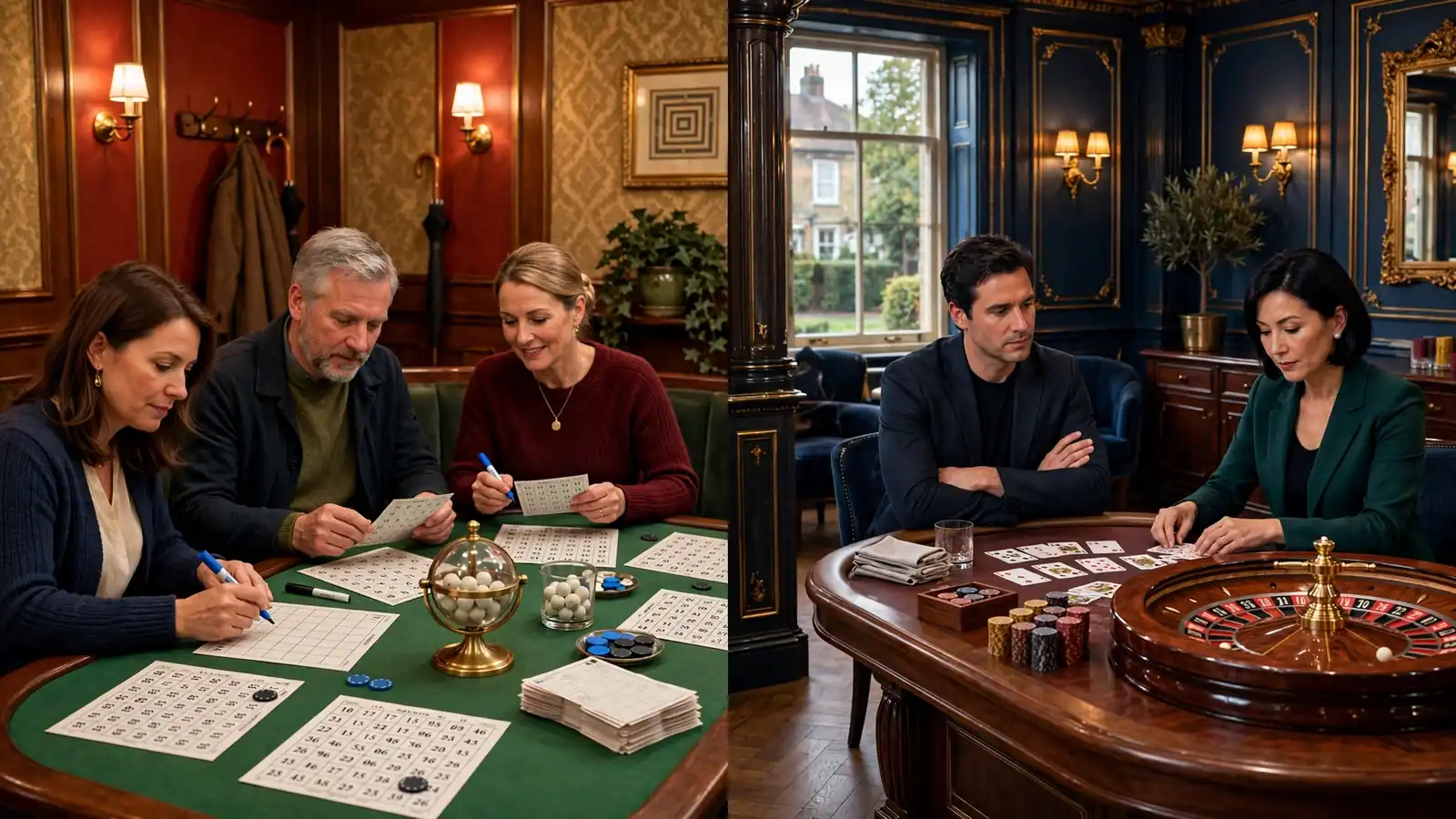

It does not mean that every detail associated with a game’s title can be inferred from the stream. A game can use a recognised theme while still having rules and features that need to be established separately. The name Monopoly Live, for example, is not sufficient grounds to state how a round proceeds, what outcomes are available or how any themed elements affect play. Those are game-specific claims, not definitions of live-dealer technology.
Nor does the label establish that every live game offers the same interaction. The shared format is limited: a human dealer conducts gameplay in a studio, the action is streamed in real time, and players use an on-screen interface to place bets. Other details belong to the particular game and should not be supplied by assumption.
A different rhythm from digital play
Live games move at a slower pace than digital versions. That is part of the format’s character, rather than a promise of a particular level of interaction or entertainment. The sequence is tied to activity in a studio, with a human dealer conducting the game as the stream reaches remote participants. Digital versions do not depend on that same live presentation.
Live games also have higher minimum bets than digital versions. This is a structural difference worth keeping separate from the theme or title of a game. A branded presentation does not remove the financial conditions associated with the live format, and the minimum applicable to a specific table is not established by the words “Monopoly Live” alone.
The pace and betting interface together shape what the format is: a streamed, dealer-led game with remote participation through screen-based controls. That description is deliberately narrower than a review of any named game. It identifies the mechanics of access without assigning unconfirmed rules, special features or outcomes to a Monopoly-themed title.
Live Dealer Format
Gameplay is streamed in real time from a studio with a human dealer, while players use an on-screen interface to submit bets.
For a UK reader considering a live-dealer game under the Monopoly Live name, the useful distinction is between format and game specification. The format can be described in general terms: studio gameplay, a human dealer, a real-time stream and bets entered through an on-screen interface. The title alone cannot fill in the remaining details. A careful account keeps those two layers apart rather than treating a recognisable name as proof of how the game operates.
Playing Online: What the Live Format Requires
Playing a live casino game online depends on more than opening a game window. The stream and the betting interface need a stable internet connection, while the pace differs from that of a digital game. These conditions matter to anyone considering Monopoly Live online: the general demands of live play can be described, but they do not establish the specific rules or availability of that title at any particular casino.
A stable connection is a practical requirement because the game is presented in real time. A weak or inconsistent connection can interrupt the experience or make it harder to follow what is happening on screen. The issue is not merely whether a page loads once. The stream needs to remain usable while the game is under way, and the interface needs to respond well enough for participation to make sense. If either becomes unreliable, the session may no longer be practical.
That is a different standard from simply being able to access a casino website. A page can open successfully while a live stream remains unstable. Online access, therefore, is not the same as suitable conditions for live play. A connection that repeatedly drops or struggles to carry the stream can undermine the continuity on which a real-time game depends. No claim about a particular device, connection speed or technical setup follows from that general requirement.


The pace also changes the shape of the session. Live games move more slowly than digital versions, so participation is less compressed. The player is following a game that unfolds in real time rather than one that proceeds at the faster tempo associated with a digital version. That difference affects how long a session feels and how quickly events follow one another. It is a feature of the format, not evidence that a game is more favourable or that a result is more predictable.
For a Monopoly Live online casino search, the distinction between a game title and the live format is important. The phrase can express an interest in playing a named game online, but the general facts about live casino play do not confirm which operators carry it, what its interface includes or how its rules work. Those details should not be inferred from the words “live casino”. What can be said is that live play carries the broad conditions of real-time streaming: a stable connection and a slower rhythm than digital play.
The slower rhythm has a practical consequence for planning. A live session should not be treated as interchangeable with a quick digital game simply because both appear on a screen. Time is part of the format. The stream must be followed as events occur, and the pace is set by live play rather than by rapid digital presentation. This does not establish a fixed session length; it means only that the experience proceeds more slowly.
- Ensure a stable internet connection for the real-time stream
- Account for the slower rhythm of live play
- Treat live sessions as interchangeable with rapid digital games
- Assume online access alone guarantees a suitable stream
Connection quality and pace are separate considerations. A stable stream does not make a live game faster, and a slower format does not remove the need for a reliable connection. One concerns whether the real-time experience can be followed; the other concerns how quickly that experience unfolds. Neither turns a general description of live games into a guarantee about a particular Monopoly Live product.
The same distinction applies when comparing an online casino with Monopoly Live UK against a digital alternative. The wording of a listing cannot, on its own, establish how the game performs or whether the listed title is available in a live format. The relevant practical question is whether the session can be followed continuously and whether its slower pace suits the intended use. Where the stream is unstable, access may exist in name while the conditions for taking part remain poor.
There is no technical shortcut that changes those basic conditions. A live game remains a real-time activity, and its pace remains slower than that of digital versions. A stable connection is therefore part of the operating environment, not an optional refinement. For online live play, the distinction is straightforward: availability describes whether a game can be opened; suitable conditions describe whether its stream can be followed as it unfolds.
Assessing a Casino Site Without a Rankings List
A site’s suitability for live play is not established by a prominent game tile, a polished studio image or a high position on a comparison page. The first material check is regulatory: a live-dealer casino serving customers in the UK must hold a licence from the UK Gambling Commission. Without that condition, the site does not meet the legal standard for offering live casino play in this market.


That makes licensing a threshold, not a quality score. It separates an eligible operator from one that is not authorised to serve the market; it does not establish that a particular game is available, that its presentation will suit every player, or that the site’s commercial terms are favourable. Those are separate questions and require evidence of their own. Treating a licence as a general endorsement would give it a meaning it does not have.
A check before a comparison
The operator’s identity and its regulatory status should be considered together. A site can display the name of a casino brand while the legal entity operating the account is identified elsewhere in its terms. The relevant question is whether the company responsible for the gambling service holds the required UKGC licence, rather than whether the page looks established or uses familiar branding. The UK Gambling Commission is the regulator responsible for licensing remote operators serving the British market.
This check matters for a page promoting Monopoly Live as much as for any other live-dealer game. A reference to the game does not itself demonstrate that the operator is licensed. Nor does a search result, a review label or a list of supposed leading casinos substitute for the regulatory condition. Rankings may organise options, but their order is not proof of legal status.
A comparison is more useful when it distinguishes what has been confirmed from what remains a claim. Licensing can be treated as a pass-or-fail requirement. Other judgments—such as ease of navigation or the prominence given to a game—are assessments of the site’s presentation, not regulatory facts. Keeping those categories separate prevents a favourable impression from being mistaken for a verified condition.
Regulatory Requirement
A live-dealer casino serving customers in the UK must hold a licence from the UK Gambling Commission to meet the legal standard.
What a ranking can and cannot show
“Best” depends on the criterion being measured. A list may rank operators by its own editorial method, but that label alone does not explain whether the comparison concerns licensing, the presence of a particular game, usability or some other feature. A ranking without a stated basis is an ordering, not a calculation. It should not be read as an independent guarantee of suitability.
The same distinction applies to claims about Monopoly Live results or rules. A casino page may describe a game, but the site’s licence does not verify every game-specific statement appearing in its marketing. Rules should be judged from the game information presented for that session; a site’s general status cannot stand in for those details. Results, likewise, are not a measure of whether the operator is the right choice. A result is an outcome, not evidence that a casino deserves a “best” label.
This is also why a claim about a Monopoly Live bonus should be assessed separately from the licence check. Regulatory status answers whether the operator meets the relevant legal requirement. It does not determine the value, usability or restrictions of an offer. Promotional language and legal eligibility belong in different columns of any sensible comparison.
For a UK player considering a live-dealer casino, the defensible sequence is therefore narrow: establish that the operator holds a UK Gambling Commission licence, then assess any other claim according to the evidence relevant to that claim. A site may be easy to use and still fail the licensing threshold; a licensed site may meet the legal requirement without being the best match for a particular preference. Neither conclusion requires a league table.

The practical value of an assessment lies less in naming a winner than in refusing to combine unlike measures. Legal status is verifiable and decisive. Branding, rankings and promotional descriptions may help identify what a site claims to offer, but they do not replace that check or prove wider quality. This is a more restrained standard than “best”, and a more useful one when money is involved.
This content is for entertainment purposes only and is not gambling advice.
Starting a Session: Pace, Stakes and Connection
A live-casino session has different practical conditions from a digital game. Live rounds move more slowly, and minimum bets are higher than on digital versions. That changes how quickly a balance can be committed: the pace may be less demanding, but a higher entry stake can make each decision more consequential.
The minimum bet is therefore a useful starting point when comparing tables. It sets the amount needed to participate in a round, not a recommended stake or a measure of how long a balance will last. The actual cost depends on the table’s terms and the bets placed. A session budget should be set before play begins, with a firm stopping point; changing it after losses or wins turns a limit into a suggestion.
A specialist review has reported starting stakes of 20p for some live roulette and baccarat tables, with higher starting limits for blackjack. That is a report from one review, not a fixed UK market rate. Table limits can differ between operators and can change, so the amount shown for a particular table is more relevant than a figure quoted elsewhere.
Before Joining a Table
- Confirm the displayed minimum stake
- Verify the stake fits the pre-set session budget
- Review the table’s specific rules and paytable
- Ensure a stable internet connection is in place
The practical check is simple: confirm the displayed minimum before joining, then decide whether that amount fits the session budget. A table can be available without being suitable for a particular budget. If the minimum is too high, the arithmetic does not improve because the game looks appealing. The same applies when a balance is nearly exhausted: a smaller remaining amount does not make a higher minimum affordable.
Pace matters alongside the stake. Live play takes longer than digital versions, so a session may involve fewer decisions over the same period. That slower rhythm does not reduce the financial effect of a bet or make outcomes more predictable. It only changes the speed at which play proceeds. A pre-set budget remains the relevant control, rather than an assumption that a slower game will cost less.
Connection quality is another session condition. Live play requires a stable internet connection; interruptions can make participation less practical. A suitable connection should be in place before a session starts, rather than treated as an optional convenience once play is under way. On a phone, the same consideration applies whether access is through a browser or an app: the device label does not remove the need for a stable connection.

Before play, the table’s rules and paytable should also be reviewed. Those terms determine how the table operates and how bets are settled; they are not interchangeable between games. This check is separate from deciding whether the minimum stake fits the budget. Both matter, and neither is replaced by familiarity with a game name.
A live session is entertainment, not a method of earning income or gambling advice. The practical decision is bounded by the visible table terms, the stake that can be afforded, and a budget fixed in advance. When any of those conditions do not fit, starting the session has no financial rationale.
What Can—and Cannot—Be Said About the Game
The name Monopoly Live points to a particular casino title, but a name alone does not establish how a game plays. The dependable description is limited to the live-dealer format: gameplay is streamed in real time from a studio, a human dealer is present, and bets are placed through an on-screen interface. That explains the general setting, not the rules of Monopoly Live itself.

This distinction matters when assessing claims about a Monopoly Live casino game. A live stream and a betting interface do not, by themselves, confirm what happens during a round, what choices are available, how a result is decided or how a payout is calculated. Those details should not be inferred from the title, from the appearance of a studio broadcast or from descriptions of other casino games.
The same limit applies to the phrase “game show”. It may be used as a label in discussion, but the format cannot be described more specifically without reliable information about the actual game. The presence of a dealer in a live casino is not proof of particular rounds, bonus events, props, audience participation or presentation features. Treating those as confirmed would turn a broad category into a set of invented mechanics.
So, how does Monopoly Live work? The answer that can be given here is narrow: it belongs to the subject of live casino play, where a studio stream shows a human dealer and bets are entered through an on-screen interface. That does not supply a complete account of the game. In particular, it is not enough to explain the sequence of play or to calculate what a particular wager might return.
A useful review has to separate what is observable about the format from what would require game-specific confirmation. The live-dealer description is meaningful, but it is not a substitute for rules or a paytable. Without those, claims about strategy, likely results or the value of a particular bet would have no sound basis. The title is not a rules document.
The practical conclusion is modest: Monopoly Live can be discussed as a live-casino game, but its individual mechanics should not be filled in by analogy with roulette, blackjack or another game-show title. Those games have their own rules; resemblance in setting or branding would not establish shared rules. This overview is for entertainment purposes only, not gambling advice.

History, Statistics and Strategy: Where the Evidence Ends
A reliable account of Monopoly Live’s history needs more than a game name and a date. It would require a substantiated chronology: when the game became available, how it changed and which details belong to each version. Without that record, a launch story or timeline would be speculation, not history. General information about live-dealer casinos cannot fill the gap; it describes a format, not the history of this particular game.
The same distinction applies to statistics. A useful record of outcomes would need to identify what was measured, over what period and how the results were collected. Without those details, a figure presented as a game statistic has no clear meaning. A sequence of past results, even if displayed in a tracker, does not by itself establish a dependable pattern or support a forecast. A history log is a record of what has already happened, not evidence of what will happen next.
That leaves little basis for a game-specific strategy. A strategy depends on the rules, available choices and the mathematical consequences of those choices. Advice that refers to Monopoly Live but cannot show how it relates to those elements is generic betting guidance wearing a specific label. It may sound precise while offering no demonstrated advantage.

This does not mean every discussion of strategy is automatically useless. It means the claim needs to match its evidence. A description of how a live-dealer game works is not proof of a profitable approach, and a set of historical results is not proof that one betting sequence is more likely to succeed. Terms such as “system”, “trend” or “hot streak” do not repair that gap.
The practical distinction is between describing a record and drawing a conclusion from it. Past outcomes can be reported accurately when their source and scope are clear. They cannot, on their own, establish a dependable prediction or a guaranteed method of play. Where those foundations are missing, a confident recommendation should be treated as marketing rather than analysis.
For an evidence-led assessment, any claimed history, statistic or strategic edge should be traceable to the game itself and explained in terms that can be checked. If that connection is not shown, the sound conclusion is limited: the claim has not established a Monopoly Live-specific advantage. The title of a strategy guide is not evidence, and a tracker’s display is not a forecast. Content about the game should separate verified description from prediction, rather than turning an unexplained pattern into a promise.
Evidence and Analysis
- Historical records are logs of past events, not forecasts of future outcomes
- Game-specific strategies require evidence from the rules and mathematical consequences
- Terms like “hot streaks” or “systems” do not provide a demonstrated advantage
- Verified descriptions should be kept separate from predictions
Casino Sites and the Terms That Change the Cost
A casino site’s headline offer is not its usable value at a live table. The relevant figure is the amount that can actually be applied to the intended game, after the bonus conditions are taken into account. For a player considering Monopoly Live, the distinction is between an offer that can be used on live games and one whose restrictions leave it tied to other products.
Live games may count for only a limited part of wagering requirements. A stated weighting of 10%, for instance, means that only a small fraction of eligible live-game stakes is credited towards the requirement. The rest does not disappear from the player’s balance calculation: it simply does not advance that bonus condition at the same rate. A large headline bonus can therefore have little practical relevance to a live-table session if the game’s contribution is low.
The calculation depends on the operator’s terms, not on the offer’s advertising label. The bonus rules need to specify whether live games qualify, how much they contribute, and whether any other restrictions apply. If the weighting is small, more qualifying play may be needed to meet the same requirement than the headline value suggests. The offer’s face value is not the amount that can be treated as freely available funds.
A specialist review reports that UK welcome promotions are often structured as slot free spins, which are not usable at live tables. That is a description of the offer type covered by that review, not a guarantee about every casino or every promotion. A welcome offer may be irrelevant to a live game even when it is prominently displayed on a casino site.

The practical comparison is therefore between the terms and the intended use: whether the offer applies to live games, what weighting those games receive, and what conditions govern the bonus. If the promotion is limited to slots, its value for live play is nil. If live games qualify only partially, the contribution rate determines how much progress the stakes make towards wagering. The headline amount comes later in the calculation, not first.
Stats and Tips Without False Predictions
Roulette statistics describe the game’s mathematical structure; they do not identify what will happen next. A record of previous results can show what has occurred, but it cannot make a future spin more predictable. The same distinction matters when considering Monopoly Live statistics: a tracker or chart is a record-keeping tool, not a forecasting system. Past results do not affect future spins or Lightning Numbers.
The stated house edge for a straight-up roulette bet is 2.9%, compared with 2.7% for other bets. These figures describe the mathematical disadvantage built into the game, not a promised loss on each individual wager. A result can differ sharply from that expectation over a short session. Changing bet size or switching selections does not remove the edge.
That makes many purported tips less useful than they sound. A sequence of recent results does not establish that a number is “due”, and a run of repeated outcomes does not make another repeat more or less likely. A tracker may organise results neatly; it cannot turn them into evidence about the next outcome. Precision of presentation is not predictive power.
Mathematical Edge
In roulette, the house edge for a straight-up bet is 2.9%, compared with 2.7% for other bets, representing a built-in mathematical disadvantage.
For anyone comparing Monopoly Live casino sites, statistics should be treated as information about the displayed game or its recorded history, not as a reason to assume a site can offer better future results. Any claim that a particular pattern, timing method or staking system can reliably forecast outcomes needs evidence beyond a chart of past spins. A system that increases stakes after losses also does not cancel the house edge; it can increase the amount at risk.
A practical approach is to decide on a spending limit before play and keep it fixed. Stopping after a win or a loss may help keep a session within that limit, but it does not improve the odds. Statistics can support a clear understanding of risk; they cannot provide a dependable route to profit. This is entertainment, not gambling advice.
Demo Play: What It Does Not Establish
A request for a Monopoly Live demo is not, by itself, evidence that a playable demonstration is available. Nor does a “demo” label establish what the mode contains, how it works or whether it reproduces the real-money game. Those details depend on the specific offer and cannot be inferred from the name alone.
The distinction matters because a demonstration, where offered, is not a record of real-money play. Its displayed results do not establish what would happen in a paid session, and they cannot support a claim about likely returns. A result shown on screen is an outcome within that particular presentation, not a forecast.
The word “demo” also says nothing about which rules or features are included. Without clear information from the operator, it is not possible to conclude that a demonstration uses the same settings as a real-money version, or that every part of the game is represented. The label is not a rule sheet.

For a UK player, the demo question should therefore be kept separate from the status of real-money play. Live dealer casinos serving the British market must hold a UK Gambling Commission licence. A demonstration does not establish that an operator is licensed, and it does not substitute for checking the operator’s status before real-money gambling.
No real payout or winnings should be attributed to demo play. It may provide a way to view a presentation if one is available, but that is not evidence of financial value or future results. This is entertainment information, not gambling advice.
A Free-Play Review, With the Limits Made Clear
A review of Monopoly Live can describe the general live-dealer format, but that does not establish how a free-play version works. Live dealer games show gameplay streamed in real time from a studio, where a human dealer manages the game. Bets are submitted through an on-screen interface. Those details describe the format, not the specific rules, controls or availability of free play for Monopoly Live.

That distinction matters when assessing claims about a free version. The label alone does not establish whether it can be opened without an account, what options it contains, or whether its presentation matches real-money play. Nor does it support claims about potential payouts. Free play should not be treated as a route to real winnings: no such outcome can be inferred from the general live-dealer format.
A useful review can therefore separate what the format supports from what a particular product would need to demonstrate. It can identify the streamed dealer and the betting interface as characteristics of live dealer games. It cannot turn those general characteristics into a description of Monopoly Live’s free-play mechanics. A confident tone is not a substitute for product-specific evidence.
For anyone comparing free and paid versions, the relevant distinction is scope: a general account of live-dealer play is not a confirmed review of a specific free-play mode. Claims about access, features or results need direct substantiation before they can be treated as part of a reliable assessment.
This page is for entertainment purposes only and is not gambling advice.
Written by the editors at Winstler Casino.