French Roulette Online Casinos in the UK: Rules and Bets
 Available in GB
See how the single-zero wheel, French rules, table formats and bonus wagering calculations shape online roulette in the UK.
- French Roulette’s Zero Rule and the Cost of a Spin
- Bet Payouts: The Return Is Fixed; the Outcome Is Not
- Online French Roulette: RNG Spins and Their Pace
- Live French Roulette: A Physical Wheel on Screen
- Low Stakes, Standard Tables and Premium Limits
- Assessing a French Roulette Casino Without a Shortlist
- Roulette Bonus Contributions: The Wagering Calculation
- Playing Roulette Online Without Treating a Streak as a Forecast
- Casino French Roulette in Britain: Licence and Player Controls
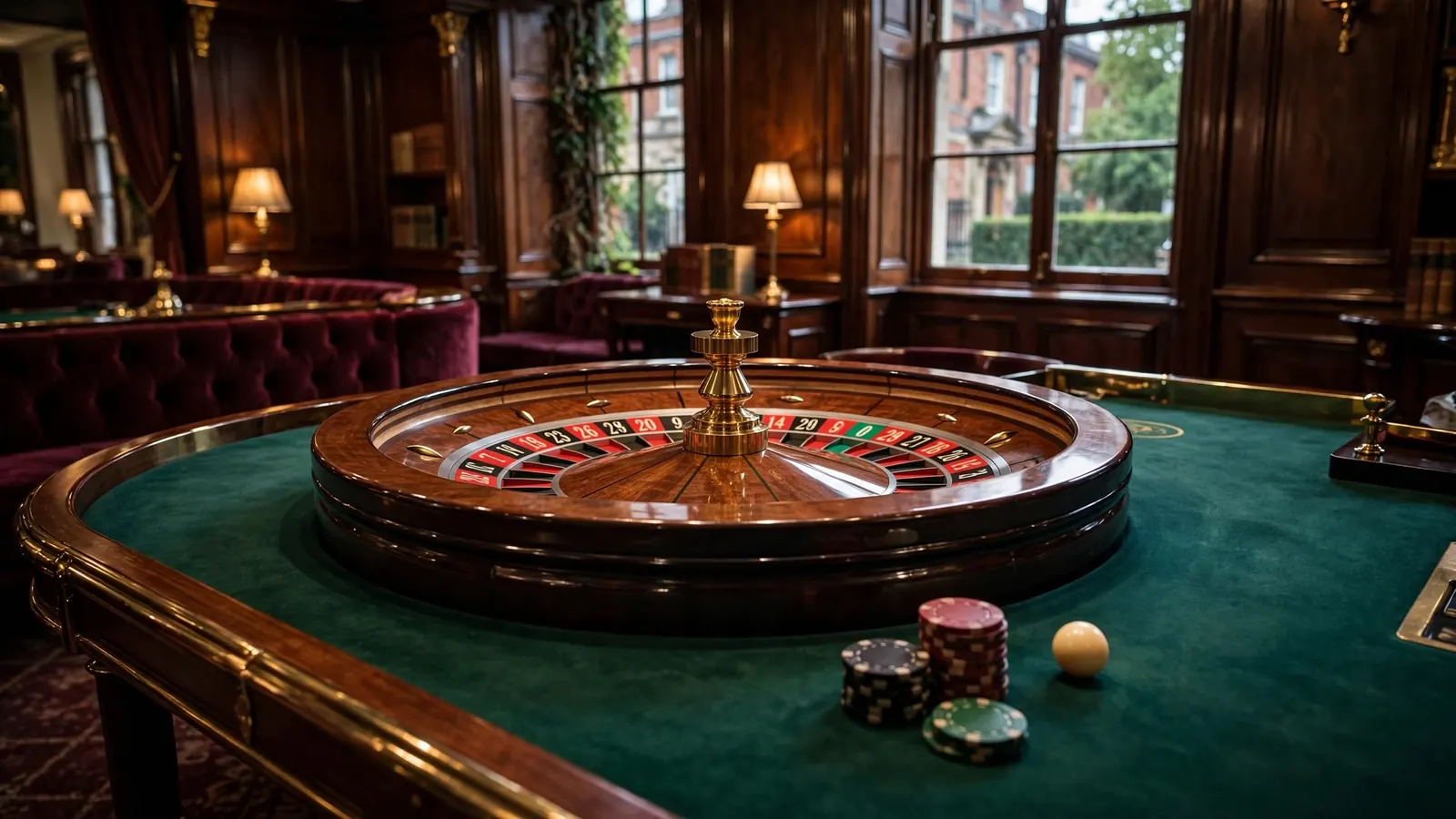
French Roulette’s Zero Rule and the Cost of a Spin
The central difference between French and American roulette is the wheel. European roulette has numbers from 1 to 36 and one zero, making 37 pockets. American roulette adds a double zero, for 38 pockets. That extra green pocket changes the chance of a winning result without changing the familiar number bets or their headline returns.
The house edge expresses the casino’s mathematical advantage over time, not the result of a particular spin. On a European wheel it is 2.70%; on an American wheel it is 5.26%. The gap comes from the additional losing outcome on the American layout. A bet that would otherwise have the same chance of winning now faces another pocket that defeats it. The single-zero wheel therefore has a lower baseline cost, before any French rules are applied.
French roulette is associated with the European wheel, but its defining feature is how certain wagers are treated when the ball lands on zero. La Partage and En Prison alter the settlement of even-money bets, such as red or black. They do not remove zero from the wheel. They change what happens to a qualifying stake when zero appears.
When choosing a UK-facing casino for French roulette, payout timing is one practical detail to check. This list gives a concise reference point for the operators featured on this page.
Payout speed: 1-3 business days Britsino lists a payout speed of 1–3 business days.
Payout speed: 1-3 business days NightLuck lists a payout speed of 1–3 business days.
Payout speed: 1-3 business days Chanze lists a payout speed of 1–3 business days.
Payout speed: 1-3 business days SpinFormula lists a payout speed of 1–3 business days.
Payout speed: 1-3 business days Amunbet lists a payout speed of 1–3 business days.
Payout speed: 1-3 business days Zombillion lists a payout speed of 1–3 business days.
Payout speed: 1-3 business days WinBeast lists a payout speed of 1–3 business days.
Payout speed: 1-3 business days BeOnBet lists a payout speed of 1–3 business days.
Payout speed: 1-3 business days EvoSpin lists a payout speed of 1–3 business days.
Payout speed: 1-3 business days Jetsetspins lists a payout speed of 1–3 business days.
Under La Partage, half of an even-money stake is returned if the ball lands on zero. The remaining half is lost. That partial refund reduces the house edge on those bets to 1.35%, compared with the European roulette baseline of 2.70%. The reduction applies to even-money bets covered by the rule; it should not be read as a lower edge for every type of wager on the table.
En Prison uses a different treatment of an even-money bet affected by zero: the stake is held rather than settled as an immediate loss. Its eventual outcome depends on the next spin and the table’s stated rule. This changes the timing and possible settlement of the wager, rather than changing the wheel’s pockets. A table’s rules matter because the label “French roulette” alone does not establish how every zero-affected stake will be handled.
The distinction between wheel advantage and bet treatment is useful when comparing versions. A single-zero layout sets the underlying European roulette edge. La Partage then lowers the edge on eligible even-money bets by returning half the stake on zero. En Prison provides another zero rule, and French roulette’s comparatively low house edge among standard variants is attributed to these rules together. The stated 1.35% figure belongs specifically to even-money bets under La Partage; it is not a universal figure for every French roulette wager.


A spin still has an uncertain result. The lower edge does not mean a red, black, odd, even, high or low bet is protected from losing, nor does it promise a favourable sequence. Zero remains part of the wheel, and a run of results can differ sharply from the long-term mathematical expectation. The edge is a measure of the terms built into the game, not a forecast for the next ball drop or a cap on how much a player can lose.
This is why the zero rule has a direct financial effect. On a table without La Partage or En Prison, zero defeats an even-money wager in the standard way. With La Partage, the same result returns half the stake. With En Prison, the wager is carried forward for resolution under the table’s rule. The ball lands in the same pocket; the settlement changes. That difference is the basis for French roulette’s lower cost on qualifying bets.
The American comparison shows why the pocket count deserves attention before a bet is placed. Both European and American roulette pay 35:1 for a straight-up bet on one number, but the American wheel has an additional pocket. Matching payouts do not make the games equivalent: the extra zero raises the house edge from 2.70% to 5.26%. French rules do not improve the chance of a number appearing; they reduce the loss associated with zero for the bets to which they apply.
Attention: French roulette rules like La Partage and En Prison only reduce the house edge for eligible even-money bets, not for every type of wager on the table.
For a French roulette casino, the practical check is therefore the table’s wheel and its zero settlement. A single-zero layout indicates the European structure. The table rules establish whether La Partage, En Prison, or both apply, and which bets qualify. Those details determine the edge relevant to the wager; the French name on the game tile is not a substitute for reading them.
Bet Payouts: The Return Is Fixed; the Outcome Is Not
A payout ratio states the profit on a winning bet relative to the stake. The original stake is also returned when the bet wins, so a 17:1 payout means the profit is seventeen times the amount wagered, with the stake added back. If the bet loses, the stake is lost. The ratio describes settlement, not how likely the selected numbers are to appear.
In a French roulette casino game, the same payout structure applies to the position chosen on the layout. A split bet covers two adjacent numbers and pays 17:1 if either one wins. A street bet covers a horizontal row of three numbers and pays 11:1 if the winning number is in that row. The split offers a higher return on a win because it covers fewer numbers; the street covers more, with a lower payout ratio.
Outside bets cover broad groups rather than a particular number or small cluster. Red or black, even or odd, and high or low each pay 1:1. A winning even-money bet therefore returns a profit equal to the stake, as well as the stake itself. These bets are settled on the same basis: the payout ratio determines the return after a win, while a losing result removes the wager.


For an online French roulette game, the payout table is the useful point of comparison when assessing what a winning selection returns. It does not turn one bet into a better forecast than another. The amount paid is fixed by the bet type; the result of the spin determines whether that payment is due.
The difference between a 17:1 split and an 11:1 street is therefore not a promise of a larger overall return. It is the stated payout for a winning selection, paired with a different number of covered pockets. Likewise, a 1:1 outside bet gives a smaller profit relative to the stake than a winning split, but the payout ratio alone does not describe the chance of winning. The figures answer a narrow question: how the wager is settled when it wins.
Online French Roulette: RNG Spins and Their Pace
An RNG version of French roulette produces each result through a random number generator rather than a ball travelling around a physical wheel. The screen presents the familiar roulette layout and a simulated spin, but the event being shown is generated by software. There is no studio wheel or dealer managing the round.
That changes the operating rhythm. Once betting closes, the result can be generated and displayed without waiting for a physical ball to settle or for a live table to move through its procedure. RNG roulette therefore allows faster play. More rounds can fit into a given session, and the interval between placing a bet and seeing its result is generally shorter than in a live-dealer format.
RNG roulette allows for a faster operating rhythm and potentially lower minimum stakes, such as 10p, compared to live-dealer formats.
The pace is a feature of the format, not a change to the underlying game. A quicker sequence does not make an individual result more predictable. Nor does a simulated animation provide evidence that a particular number or colour is due. The software supplies an outcome for each spin; the visual sequence is its on-screen presentation.
Minimum stakes are another practical distinction. RNG roulette can have lower entry points than a live table, with stakes often available as low as 10p. That makes it possible to place a small amount on a round, although a low minimum does not by itself set the total cost of a session. The number of rounds played also matters: faster play can mean that the same session length contains more decisions and more opportunities for money to be committed.
For that reason, pace and stake size need to be considered together. A small bet can still accumulate across repeated rounds, particularly when the next spin is available quickly. The format reduces waiting; it does not reduce the financial effect of continuing to play. A slower presentation is not automatically less costly, and a rapid one is not automatically more expensive. The relevant calculation is the amount staked over the session, rather than the speed label alone.

Online French roulette in RNG form is suited to play where immediate, software-generated rounds are preferred to a streamed table. Its convenience is operational: the game can proceed without a dealer’s actions or a physical wheel being shown. That should not be confused with a different set of outcomes or a special version of the rules. The software format changes how a spin is produced and how quickly another round can begin, while the table’s stated rules determine how bets are handled.
The word “random” also needs a precise reading. It describes how the result is generated, not a promise about the distribution of results over a short session. A run of outcomes can look uneven without indicating what the next one will be. Each displayed spin is a separate result; the sequence does not become a forecast merely because it is produced by software.
The useful comparison is therefore between the pace and mechanics of the available formats. RNG play removes the wait associated with a live presentation and can make low-stake rounds accessible. It also makes it easier for rounds to follow one another with little interruption. Those are practical differences in the way the game runs, not evidence that the software version offers a different kind of certainty.
Live French Roulette: A Physical Wheel on Screen
Live French roulette uses a real wheel streamed from a studio. A human dealer operates the game, and each result comes from a physical ball drop rather than a random number generator simulating a spin. The screen is therefore showing a roulette game taking place, not an animation standing in for one.
Live vs RNG French Roulette
Live French roulette uses a real wheel streamed from a studio with a human dealer and a physical ball drop. In contrast, RNG versions use software to generate results, providing a simulated spin and a typically faster pace of play.
That distinction is about the source and presentation of the result. In a live casino French roulette game, the wheel and ball are physical objects, while the dealer is part of the streamed table. The player interacts through the online interface, but the spin itself happens at the studio table. The result is conveyed on screen after the ball settles.
A live table combines two different interfaces. The streamed image presents the dealer and wheel; the betting controls let players enter wagers online. Those controls are the digital part of the experience. They do not turn the physical spin into an RNG result: the wheel shown in the stream remains the source of the outcome.
This format can be relevant when comparing live French roulette casinos in the UK with automated versions. The defining feature is not a different way of displaying a roulette layout, but the presence of a streamed, human-operated game and a physical ball drop. The studio setting also means that the experience is presented as a continuous event rather than as a sequence of generated animations.
The camera view matters because it determines how much of that event is visible. The stream may show the wheel and dealer as the spin unfolds, while the online interface provides the controls and displays the resulting number. The arrangement keeps the physical game and the digital betting tools in view as separate parts of one session. A stream is still a presentation: the screen cannot reproduce the physical room, and the player is not handling the wheel or ball.
The word “live” should not be confused with “auto”. A live game has a human dealer and a physical ball drop, according to the format described here. An auto-labelled table may refer to a different product, but the label alone does not establish whether its result comes from a physical wheel or a random number generator. The game information needs to identify the actual format; a table name is not a technical explanation.

For the same reason, a live French roulette casino is not simply any page that displays a French roulette layout. The relevant details are whether the game is streamed from a studio, whether a human dealer is present, and whether the result is produced by a physical wheel. Those characteristics define the live format. The layout on screen may resemble other online versions, but resemblance does not identify how the spin was generated.
A stream also changes what the player sees, not the basic role of the betting interface. Wagers are still placed through on-screen controls, while the dealer and wheel provide the visible setting for the spin. The camera gives the game a physical context; it does not make the session a face-to-face table or remove the need to use the online interface.
For anyone assessing online live French roulette, the useful distinction is therefore straightforward: the game is presented from a studio, a human dealer operates it, and the ball physically lands on the wheel. These features explain what “live” means without implying that the stream changes the rules or predicts the next result.
Low Stakes, Standard Tables and Premium Limits
A roulette table’s minimum is the price of entering a round; its maximum is the ceiling on an accepted wager. Neither figure describes the likely cost of a session. That depends on how many spins are played, how much is placed on each one and whether the stake changes. A low entry point can make individual decisions smaller, but a faster format can create more decisions in the same period. The table limit and the pace therefore need to be read together.
Low-stake tables
A low minimum makes it possible to place a small wager without having to meet a higher opening amount. In a specialist review, UK live roulette minimums are reported as starting at 10p, while some auto-roulette and speed tables are recorded with a 5p entry point. These are reported examples, not a promise that every operator or table will offer those levels. The stated minimum can differ between games, formats and operators.
The practical value of a low minimum is control over the size of each individual wager. It does not, by itself, set a session budget or limit the number of rounds. A stake that appears small on a single spin accumulates across repeated play, so the total outlay is better understood as the sum of the wagers placed, not as the table’s entry figure. If a table also sets a maximum, that upper boundary matters whenever a stake is increased; a progression that reaches it cannot continue as intended.
Low stakes can suit play where the amount committed per round is the primary constraint. But a low minimum is not the same as low overall exposure. At a quicker table, more rounds may be completed in a given time, leaving the total amount wagered dependent on both the stake and the pace. The entry figure is only one line in the cost calculation.

Standard tables
A standard table is a middle ground in format rather than a fixed stake category. Its displayed limits determine what can be wagered, while the game’s pace determines how frequently those wagers can be made. A specialist review places standard roulette at roughly 80 to 100 spins in an hour, with speed roulette exceeding 150 in the same period. These reported rates describe the pace of play, not a guaranteed schedule for every table.
The difference matters because a session can involve more wagering opportunities without any change to the stake per round. If the stake remains constant, a higher spin rate increases the number of times that amount can be committed. If stakes vary, the calculation becomes less direct, but the principle is unchanged: the total is driven by the wagers actually placed. A table’s minimum cannot show that total on its own.
Standard limits may offer more room between the minimum and maximum than a low-stake table, but the range must be checked on the table itself rather than assumed from its label. “Standard” is not a defined stake band shared across every roulette product. The label may distinguish a format or presentation, while the actual limits remain specific to that game.
Offer low entry points (sometimes as low as 5p or 10p) to allow control over the size of individual wagers.
Provide a middle ground with a moderate pace, typically averaging 80 to 100 spins per hour.
Permit larger maximum wagers and may have higher minimum entry points for high-limit play.
Premium and high-limit play
Premium or high-limit tables are identified by the larger stakes they permit, not by a different guarantee of outcome. A higher maximum allows larger wagers; it does not improve the predictability of a spin or reduce the amount exposed when a bet loses. The operational distinction is therefore the size of the possible commitment, not a special financial advantage.
The minimum also matters at this end of the range. A high maximum is of little relevance to someone placing small wagers, but a raised minimum can make a table unsuitable even when its upper limit is not used. Both ends of the range should be considered: the minimum determines whether a stake can be placed at all, and the maximum determines how far it can be increased.
Premium presentation can make a table feel separate from a standard one, but the financial terms remain the useful measure. A larger permitted wager changes the possible amount at risk per round. It does not change the number of rounds required to spend a given amount, unless the chosen format also plays at a different pace. Those are distinct variables and should not be treated as one feature.
Comparing the practical cost
A simple comparison starts with three details: the minimum stake, the maximum stake and the format’s pace. The minimum answers whether the opening wager fits the intended stake size. The maximum shows the boundary on larger wagers. The pace indicates how quickly repeated decisions can add to total wagering. Missing any one of these leaves an incomplete picture of the table’s practical cost.

For a low-stake session, the entry point may be the first constraint, but it is not the only one. A table with a low minimum can still allow rapid accumulation if rounds follow quickly. For standard play, a moderate pace and a usable range of limits may matter more than the table’s label. For premium play, the central question is how much can be committed per round, including whether the minimum itself is already above the intended stake.
No universal price tag separates low, standard and premium roulette. These are useful descriptions of the relationship between limits and format, not fixed categories with identical terms everywhere. The posted table limits give the actual boundaries; the pace gives context for how often those boundaries may be used. Together, they provide a more accurate view of the amount a format can expose than its name or presentation alone.
Assessing a French Roulette Casino Without a Shortlist
A useful comparison is not a league table. It is a check of whether the casino makes the terms of a particular French roulette game clear enough to assess before play. The same operator can offer several roulette titles with different rules, formats and limits, so a casino-wide label is not sufficient evidence that every table provides the same conditions.
Confirm the game, not just the label
Start with the title and its rules screen. “French roulette” should identify a specific game, not function as a general category covering any roulette table. The rules should state which wheel and betting conditions apply, including whether La Partage and En Prison are available and which bets they affect. If the game page and the rules screen describe different conditions, that discrepancy is a comparison result in itself: the terms are not presented consistently.
Verifying Game Terms
- Confirm the specific game title and rules screen
- Check if La Partage or En Prison rules apply
- Identify which specific bets qualify for zero-settlement rules
- Verify the game-specific RTP disclosure
- Check the minimum and maximum stake limits
The distinction matters because the name alone does not establish the settlement rules. A casino that provides a direct link to the table’s rules, and keeps that information available before a wager is placed, is easier to assess than one where essential conditions are buried or unclear. The comparison should record what the selected game actually states, rather than infer its features from a lobby image or a general description of French roulette.
Check RTP disclosure at game level
RTP information should be accessible for roulette games offered by UKGC-licensed operators. The relevant figure needs to be associated with the particular title and its rules, rather than displayed as a generic casino statistic. A casino’s overall RTP figure cannot answer what applies to a French roulette game, and a figure without a clear game reference is difficult to use.
The practical test is straightforward: can the published information be found before play, and can it be matched to the exact table? If the game has more than one rules configuration, the disclosure should make clear which configuration the RTP refers to. If the figure is absent, or the page does not identify the game it covers, mark it as unavailable or unclear rather than treating another roulette title’s information as a substitute.
RTP is a comparison measure, not a forecast for an individual session. Roulette outcomes are determined by chance; no strategy can predict the final result. A published return figure describes the game on its stated basis, not the amount a particular player will receive. Treating it as a promise of a personal result would make the comparison less accurate, not more reassuring.
Record what can be verified
A compact comparison sheet can separate confirmed terms from presentation. For each casino and title, record the exact game name, the rules page, the RTP disclosure and whether those details agree. Then note the displayed minimum and maximum stake for that table, as well as any conditions attached to the selected format. Those limits can change between tables, so a figure shown for one game should not be carried across to another.

The aim is not to award points for a polished lobby. It is to identify where the decision-critical terms are visible and where they remain uncertain. A clear rules page and game-specific RTP disclosure are evidence; a promotional description is not a replacement for either. Missing information should remain marked as missing rather than being filled in by assumption.
Presentation can still affect the practical comparison, but it should be assessed separately from the game’s terms. Check whether the table can be identified reliably in the lobby, whether its rules are reachable without beginning a game, and whether the stated conditions remain visible on the game screen. These checks do not alter the odds. They establish how readily the operator communicates the conditions under which the game is offered.
Separate casino claims from game terms
Search results and promotional pages may use broad claims about having the best French roulette casino or offering the best online French roulette experience. Those claims do not provide a measurable basis for ranking. A meaningful comparison needs the exact title, its applicable rules, accessible RTP information and the limits shown for that table. Without those details, the claim says more about presentation than about the game.
For a British comparison, the operator’s UKGC status is also a threshold check, not a quality score. A UKGC-licensed operator should make the relevant roulette information accessible; the licence does not establish that every table has identical terms or that one casino is automatically superior. Comparing the evidence at game level avoids turning a general operator label into a conclusion about a particular French roulette table.
The result need not be a single winner. One casino may make rules easier to verify, while another may present the game-specific information more clearly. Where either leaves material terms uncertain, that uncertainty belongs in the assessment. A defensible comparison distinguishes what is published from what is assumed—and does not mistake a confident headline for a settled calculation.

Roulette Bonus Contributions: The Wagering Calculation
A roulette stake does not necessarily count in full towards a bonus wagering requirement. The operator applies a game weighting: the percentage of each qualifying wager credited to the required total. The calculation is separate from whether a spin wins or loses. A winning stake does not automatically qualify in full, and a losing stake is not necessarily excluded.
The basic calculation is:
qualifying wagering = roulette stakes × game weighting
At a 10% weighting, only a tenth of the eligible stakes is credited. At 20%, a fifth is credited; at 100%, the full amount counts. The balance is not erased from the player’s account, but it does not advance the bonus requirement. This distinction matters because the amount wagered at the table can be substantially higher than the amount recognised for bonus terms.
For instance, where live roulette carries 10% weighting and RNG roulette carries 100%, the same total stake generates ten times as much qualifying wagering on the RNG game. That comparison concerns bonus accounting, not the chance of a particular result. The relevant rate is the one attached to the promotion and game category in the operator’s terms.
UK operators commonly apply a 10% to 20% weighting to roulette, though the rate varies. RNG roulette may count at 100%, while live roulette may be credited at 10% or 20%. Those are not universal settings: a French roulette table does not acquire a particular weighting simply because it is French roulette. The promotion’s terms may classify games by format, provider or game type, so the exact table listing matters.
No-deposit promotions can use narrower rules. Some UK operators exclude live roulette from wagering altogether; where it is included, a specialist review reports contribution rates from 0% to 10%. A zero rate means that a live roulette stake contributes nothing to the wagering total. A positive rate still does not make the full stake eligible. The promotion’s own terms determine which treatment applies.
Bonus Wagering Calculation
Determine the amount wagered on the roulette table.
Multiply the stake by the percentage assigned to that game category (e.g., 10% for live roulette).
The resulting figure is the amount credited toward the bonus wagering requirement.
The same review reports that UK regulations have capped bonus wagering at 10x since January 2026. This should be treated as a claim made by that review, not as a substitute for checking the terms governing a specific offer. A stated wagering multiple and a game weighting answer different questions: the multiple sets the required total, while weighting determines how quickly qualifying play accumulates.
A clean comparison therefore needs both figures. First identify the wagering requirement attached to the bonus; then find the roulette weighting and confirm whether it applies to live play, RNG play, or both. If the weighting is absent or the game category is unclear, the amount of roulette play needed cannot be calculated reliably. The headline bonus value is packaging; the eligible stake and its weighting determine the actual route through the requirement.
Playing Roulette Online Without Treating a Streak as a Forecast
The Martingale system changes the stake after a loss: the next bet is doubled, and the sequence continues until a win or the available bankroll is exhausted. The logic is straightforward; the exposure is less comfortable. Each loss makes the next required stake larger, so a losing run can consume funds quickly.
A sequence of doubled bets does not make a win more likely on the next spin. Roulette outcomes are determined by chance, and no staking pattern can predict the result. The system changes how much money is committed, not what the wheel will produce.
For anyone choosing to play French roulette online at a casino, a staking plan is therefore a spending rule, not a forecast. Its practical test is whether the full sequence can be funded without using money set aside for other purposes. If the plan depends on a win arriving before the next stake becomes unaffordable, the risk sits in the assumption, not in the arithmetic.

A bankroll can be reduced by repeated losses even when each individual bet appears manageable. Doubling also means that the later stakes in a sequence account for a much larger share of the total money at risk than the opening bet. Keeping stakes fixed avoids that escalation; stopping after a set loss can contain spending. Neither approach changes the chance-based nature of roulette. The Martingale label does not turn a run of outcomes into a schedule.
Casino French Roulette in Britain: Licence and Player Controls
The UK Gambling Commission (UKGC) is the sole regulator of online casino activity in Great Britain. A site offering real-money French roulette to British residents must hold the relevant UKGC operating licence; a platform without a valid licence cannot legally offer real-money live roulette in Britain. The roulette table’s presentation does not change that requirement.
Age verification must take place before a customer can deposit into a gambling account. Before a first deposit, a remote operator must also prompt a new customer to set a financial limit and provide accessible account-level controls. UKGC-licensed live casino operators must offer deposit and loss limits, session-time reminders, reality checks, cool-off periods and GamStop self-exclusion.
A licence is a regulatory condition, not a substitute for checking the terms attached to a particular game. RTP information for roulette must be accessible, and the operator must provide an internal complaints process and access to an approved Alternative Dispute Resolution service. UKGC licensees are also required to contribute to the Research, Education and Treatment levy.
Before depositing, the operator’s licence number can be checked against the UKGC public register. This establishes whether the business is authorised to serve the market; it does not turn a roulette result into a predictable one. The controls govern account access and gambling activity, while each spin remains a separate chance-based outcome.
Should I play American or European roulette if I’m in the UK?
European roulette has the lower house edge: 2.70%, compared with 5.26% for American roulette. On eligible even-money bets, La Partage can lower the edge on a European-style French table to 1.35%.
What is the difference between European and American roulette wheels?
European roulette has 37 pockets: numbers 1–36 and one zero. American roulette has 38, adding a double zero; the house edge is 2.70% on European roulette and 5.26% on American roulette.
How does the 10x wagering cap affect roulette bonuses?
Since January 2026, UK-licensed operators can set bonus wagering requirements of no more than 10 times the bonus. Roulette may contribute only part of that requirement: live roulette commonly counts at 10%–20%, while RNG roulette may count at 100%, depending on the operator.
Published by the Winstler Casino team.