UK Casino Sites and Credit Card Gambling Rules
 Available in GB
The payment route and source of funds matter: a debit card on a familiar network is not the same as a credit card.

- Can a Credit Card Be Used for Gambling in the UK?
- Why the Credit Card Gambling Ban Still Applies
- What “Credit Card Casino” Means in the UK
- Casino Cashiers That Accept Card Deposits
- Paying for Casino Deposits Without a Credit Card
- Credit Card Payments, Wallets and the UK Ban
- Credit Card Casinos Not on GamStop: What the Search Term Does Not Prove
- Checking Deposit and Withdrawal Compatibility
- Credit Card Slots and the Payment Route
Can a Credit Card Be Used for Gambling in the UK?
No. A credit card cannot be used to fund online gambling at a UK-licensed casino. Remote gambling licensees are not permitted to accept credit-card payments for gambling, so a credit-card deposit should not be treated as an available way to pay, even when a payment page displays a general card logo.
The distinction that matters is the source of the funds, not the shape of the card or the fact that a transaction travels through a familiar card network. A credit card provides borrowed funds; a debit card draws on money held in a bank account. Those are different payment products, even when both carry the Visa or Mastercard name.
UK casinos commonly accept debit cards, including Visa and Mastercard. That does not make credit cards on the same networks acceptable for gambling. A logo identifies a network, not necessarily the eligible card product. Whether a particular debit card can be used depends on what the casino’s payment process supports and on the card and account being used. The presence of a card-payment option is not permission to use credit rather than debit.
When looking for a UK casino that accepts credit cards, check the payment options and current rules directly with the operator. The available information here gives payout speeds, but does not confirm credit card acceptance.
Payout speed: 1-3 business days Britsino’s listed payout speed is 1–3 business days. The available information does not confirm whether it accepts credit cards.
Payout speed: 1-3 business days NightLuck’s listed payout speed is 1–3 business days. The available information does not confirm whether it accepts credit cards.
Payout speed: 1-3 business days Chanze’s listed payout speed is 1–3 business days. The available information does not confirm whether it accepts credit cards.
Payout speed: 1-3 business days SpinFormula’s listed payout speed is 1–3 business days. The available information does not confirm whether it accepts credit cards.
Payout speed: 1-3 business days Amunbet’s listed payout speed is 1–3 business days. The available information does not confirm whether it accepts credit cards.
Payout speed: 1-3 business days Zombillion’s listed payout speed is 1–3 business days. The available information does not confirm whether it accepts credit cards.
Payout speed: 1-3 business days WinBeast’s listed payout speed is 1–3 business days. The available information does not confirm whether it accepts credit cards.
Payout speed: 1-3 business days BeOnBet’s listed payout speed is 1–3 business days. The available information does not confirm whether it accepts credit cards.
Payout speed: 1-3 business days EvoSpin’s listed payout speed is 1–3 business days. The available information does not confirm whether it accepts credit cards.
Payout speed: 1-3 business days Jetsetspins’ listed payout speed is 1–3 business days. The available information does not confirm whether it accepts credit cards.
This is the practical answer to questions about paying at an online casino, depositing into a gambling account or playing slots with a credit card: the game does not change the payment rule. A slot deposit is still a gambling payment. Nor does the word “casino” in a payment description make the transaction a general retail purchase that can be placed on credit. The relevant test is whether the money is being used for gambling.
For online play, legal access also depends on the operator’s status. Real-money gambling in Great Britain must be provided by a remote gambling licensee holding the relevant UK Gambling Commission licence. The credit-card restriction applies to those licensed services; an operator cannot make a credit-card gambling deposit acceptable simply by describing the site or cashier differently. A site’s willingness to take a payment is not, by itself, evidence that the payment is permitted.
A declined transaction or an absent credit-card option is therefore consistent with the rule, rather than a technical inconvenience that should be bypassed. A card may look like a standard payment choice while still being unsuitable because it is a credit product. The same reasoning applies whether the intended payment is a first deposit or a later top-up.
That leaves a clear dividing line: debit-card payments may be offered, while credit-card payments for gambling are not an allowed deposit route at a UK-licensed online casino. The two should not be conflated merely because they share a card brand or appear under one broad “cards” label. A payment method’s name and the source of its funds both matter.


The restriction is not limited to table games or to a particular casino format. It concerns credit-card payments for gambling, so changing from roulette to slots does not alter the answer. For a UK customer considering an online casino deposit, the relevant distinction is credit versus debit—not whether the intended game is a slot, a table game or another gambling product.
Why the Credit Card Gambling Ban Still Applies
The UK restriction took effect on 14 April 2020. Since that date, remote gambling operators have been prohibited from accepting credit-card payments for gambling. The rule has not been relaxed, so the date marks the start of an ongoing restriction rather than a temporary measure that later expired.
That timeline matters when assessing older information about casino payments. A page or discussion written before the restriction took effect may describe arrangements that no longer reflect the rules. The relevant position is the one in force now: credit cards cannot be used to fund gambling with UK-licensed casinos. The fact that a payment card is technically capable of making a transaction does not make that transaction permissible for gambling.
The restriction remains part of the framework governing remote gambling in Great Britain. Operators serving customers in England, Scotland and Wales must hold a UK Gambling Commission licence, and licensed operators must follow the applicable payment rules. A change in an individual casino’s cashier options does not alter the date the restriction began or remove the rule.
UK Credit Card Ban
Remote gambling operators are prohibited from accepting credit-card payments for gambling; this restriction has been in force since 14 April 2020.
The question of why credit cards were banned is best kept separate from claims about particular operators or payment products. The established point is the regulatory decision itself: the regulator introduced the prohibition on credit-card gambling, and it remains in force. No later relaxation has restored credit-card funding for gambling at UK-licensed casinos.
This also means the rule should not be treated as a short-lived response that can be ignored once a casino changes its branding, cashier layout or payment-provider arrangements. The restriction concerns credit-card payments for gambling, not the age of a website’s payment page. A method appearing in an old description is not evidence that credit-card gambling is now allowed.
The date is fixed; the status is continuing. For UK online casinos, the relevant regulatory position is therefore not determined by when an operator opened, when a payment method was added, or how an older review described it. The credit-card gambling ban began on 14 April 2020 and remains in force.
What “Credit Card Casino” Means in the UK
The phrase “credit card casino” can describe a search category, an old payment-method label or a page that lists card brands. It does not establish that a UK customer can fund gambling with a credit card. A UK-licensed casino cannot accept credit-card payments for gambling, so a card logo or generic claim about card deposits is not proof of credit-card eligibility.
The distinction is between the brand and the product. Visa and Mastercard issue or process different card products, including debit cards. A casino page that names either brand may be referring to debit-card deposits, not credit-card payments. Even a payment-method list that says “Visa” or “Mastercard” does not settle which card type is accepted for a UK account.


The relevant evidence is the payment option presented to the customer after signing in and selecting the UK market. A specialist review may list Visa and Mastercard, but current availability and eligible card products still need to be checked in the casino’s cashier. The cashier’s wording matters: a general card symbol is less informative than an explicit description of the permitted product and transaction type. If the site does not distinguish them, the label remains ambiguous.
That check should be made before treating a site as a card option. A payment method can appear on a general information page yet be unavailable for a particular account, customer location or card product. The casino’s own terms and the live deposit screen are more relevant to that specific transaction than a broad claim that it “accepts cards”.
Currency is another separate condition. A specialist review may state that GBP is supported, but the account currency should still be confirmed before the first transaction. If the account is set to another currency, a deposit may involve conversion rather than a direct payment in pounds. The card brand alone says nothing about the currency applied to the account.
Accordingly, “online casino credit card” is not a reliable description of a permitted UK deposit route. It may point to a page using loose terminology, a debit-card option, or information that does not reflect the current UK cashier. For a UK-licensed site, a genuine credit-card gambling deposit is not an available interpretation. The practical test is whether the live payment screen identifies an eligible debit-card product, not whether the site’s headline or logo list mentions a familiar card network.
Card Brand vs Product
Visa and Mastercard logos identify the payment network, not the card product. A casino may accept debit cards on these networks while still prohibiting credit cards.
Casino Cashiers That Accept Card Deposits
A card logo on a casino’s payment page does not establish that a UK customer can make a gambling deposit with a credit card. Visa and Mastercard are payment networks used for different card products. A listing may refer to debit cards, and it does not override the restriction on credit-card payments for gambling at UK-licensed casinos.
The practical check is the cashier available to the account, not a general payment-method list elsewhere on the site. A specialist review may report Visa or Mastercard as supported, but that information cannot confirm current UK availability or whether a particular card product is eligible. Those details need to be checked in the operator’s cashier before a deposit is attempted.
What a card listing does—and does not—show
A payment-method page is a broad indication of the routes an operator may support. It may not distinguish clearly between debit and credit cards, or between availability in different markets. The logo alone answers only which network is mentioned; it does not identify the funding source accepted for a UK gambling transaction.
That distinction matters because the same network can appear on both debit and credit cards. A Visa or Mastercard debit card may be offered for deposits, while a credit card bearing the same logo cannot be used for gambling. The brand is not the deciding detail. The card product and the payment route are.

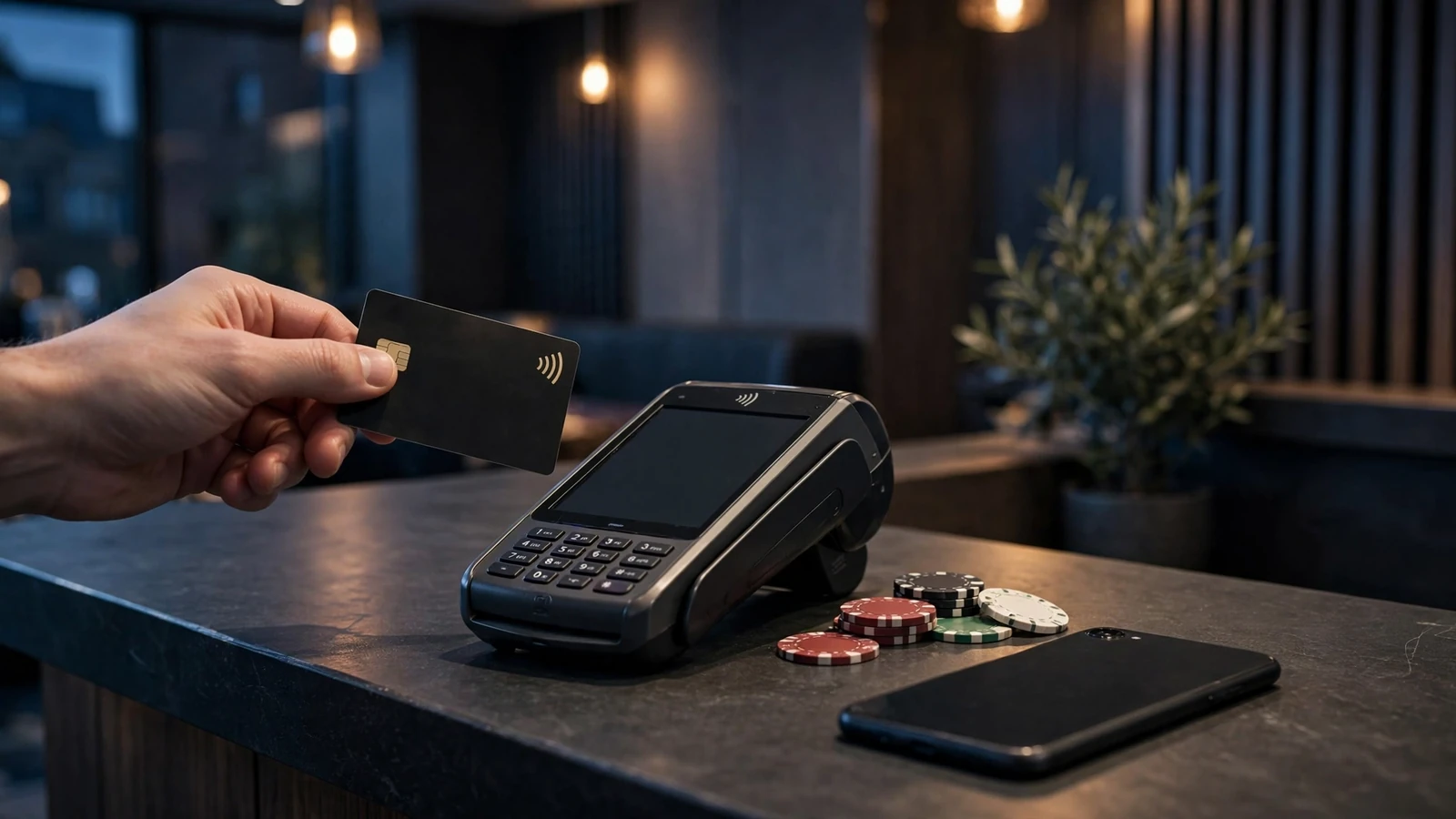
A casino’s terms or promotional page can therefore be incomplete for this purpose. Even where a page names Visa or Mastercard, the cashier is the relevant place to confirm whether that method is currently available to a UK account and whether the card product is eligible. If the information is unclear, the logo should not be treated as permission to proceed with a credit card.
A practical cashier check
The check should be made before entering payment details. First, confirm that the account is for the UK market and that the casino holds a current UK Gambling Commission operating licence. The public register can be used to verify the licence number. An operator serving British customers cannot substitute a foreign licence for the required UK licence.
Next, open the cashier and read the card method’s label and any accompanying conditions. A listing for Visa or Mastercard should be treated as a network reference, not as confirmation that credit-card deposits are accepted. If the method is described as debit card, that is the relevant distinction. If the wording does not identify the card type, the eligibility is unresolved until the operator clarifies it.
The payment screen should also be checked for any method-specific deposit conditions before a transaction is submitted. Minimum deposits can differ by payment method; a specialist review has reported starting points in the £10–£20 range, but that is not a fixed rule for every cashier. The amount shown for the selected method and account is the operative figure. Deposit ceilings can also differ by method and account status, including limits set per transaction or over a period. The cashier’s displayed terms are more useful than a general statement on a review page.
- Confirm the UK Gambling Commission licence on the public register
- Check for the specific “debit card” label in the cashier
- Verify minimum and maximum deposit limits in the live screen
- Treat a general card logo as permission to use credit
- Retry a failed credit-card payment through different routes
- Assume a site is compliant based on a general review page
A card being visible does not establish that every card bearing its logo will work. Nor does a failed transaction prove that the casino accepts credit cards but has a temporary technical problem. The sound conclusion is narrower: the particular method and product have not been confirmed as eligible. Do not keep retrying a credit-card payment through a different screen or route.
If the cashier gives an unclear answer
A vague label should be treated as a request for clarification, not as a loophole. The operator’s customer support can be asked whether the listed Visa or Mastercard option is restricted to debit cards for UK gambling deposits. The response should address both the customer’s UK account and the card product, rather than simply repeating that the network appears on the site.
The answer should also be checked against the cashier and the operator’s terms. If those sources conflict, the transaction should not be treated as authorised on the strength of the more permissive wording. A general payment page can be outdated or written for several markets; the account-specific cashier is the more direct indication of what is available at that point.
For an operator with a UK licence, the relevant boundary is not a technical setting in the cashier. Remote gambling licensees cannot accept credit-card payments for gambling. That remains the case if a card logo appears in a general list or a payment attempt reaches an intermediary. A site that explicitly invites UK customers to fund gambling by credit card is not made compliant by describing the card brand rather than the product.
What to record before depositing
A brief check can prevent confusion later:
- Confirm the operator’s current UK Gambling Commission licence on the public register.
- Check the payment methods shown in the UK account’s cashier.
- Distinguish a debit-card option from a generic Visa or Mastercard reference.
- Read the displayed minimum and maximum deposit conditions for that method.
- Seek a clear answer from the operator if card-product eligibility is not stated.
These checks establish whether a permitted card deposit route is actually available; they do not make credit-card gambling deposits permissible. If the cashier identifies only a card network without specifying the eligible product, the answer is still incomplete. If it identifies a debit card, the product must be a debit card rather than a credit card. If it does not show a suitable method, a listing elsewhere on the site cannot fill that gap.
The distinction is less convenient than a logo, but more precise. A cashier can confirm what the operator offers to the account; it cannot convert a prohibited credit-card payment into an acceptable one. For UK customers, “card accepted” is not a sufficient test. The payment method must be available for the account, the product must be eligible, and the funding must not be a credit-card payment for gambling.
Paying for Casino Deposits Without a Credit Card
A casino deposit can be funded through several routes that do not involve a credit card. The practical choice depends on what the cashier makes available to the account, whether the payment account belongs to the same customer, and whether any promotion excludes that method. Availability is not universal: a payment service appearing on a general information page does not guarantee that it will be offered to every UK customer.
Commonly accepted via Visa and Mastercard; funds are drawn from a bank account rather than borrowed.
Services like PayPal, Skrill, and Neteller that act as an interface, though some may be excluded from promotions.
Paysafecard options used for funding deposits only, not for receiving payouts.
Open banking and transfers allowing instant deposits, often requiring app-based authentication.
Debit cards
Debit cards are a familiar option at UK casinos, with Visa and Mastercard among the card brands commonly accepted. The payment comes from money held in the linked bank account rather than borrowed credit, but acceptance still depends on the casino and the particular card. Issuer controls, card type or a mismatch in account details can prevent a transaction from being authorised.
The cashier is the relevant check: it shows which card options are currently available for the account and any transaction conditions attached to them. The cardholder name should match the casino account holder. Using payment details belonging to another person can create avoidable ownership checks and payment delays.
E-wallets
PayPal, Skrill and Neteller are examples of e-wallets that may be available at some casinos. They can provide a separate payment interface between a bank account and a casino cashier, but their presence should not be treated as a guarantee of eligibility for every offer.
A specialist review has described PayPal as valued for speed and convenience while noting that some promotions may exclude it. That is a terms-and-conditions issue, not a fixed rule across all casinos: the promotion’s payment exclusions determine whether a deposit qualifies. Skrill and Neteller are also reported at some sites, with promotional exclusions noted for these methods as well. The offer terms should be checked before depositing if the bonus value forms part of the calculation.

An e-wallet is useful only if its own funding rules and the casino’s cashier conditions fit the intended deposit. A wallet name alone says little about the source of the funds or whether a specific transaction will be accepted. The payment route should be checked in the wallet and casino account rather than inferred from a logo.
Prepaid vouchers
Paysafecard is a prepaid voucher designed for deposits. It can separate a casino payment from a bank-card transaction, but it is deposit-only, so it should not be treated as a complete payment route for receiving casino funds. If a deposit method cannot support the later payout process, another payment method may be required and further checks may follow.
The voucher’s practical value is therefore limited to funding the account. Its availability in the cashier, any minimum or maximum transaction conditions, and the casino’s rules on alternative payout methods should be reviewed before choosing it.
Bank-based payments
Open banking and bank transfers are another route. A specialist review reports that these can allow instant deposits and fast withdrawals at many sites, but timing depends on the casino and the payment service used. Bank-based options may require approval through a banking app or another authentication step, and the account details should belong to the casino customer.
Choosing a Payment Route
The usable deposit route is determined by the cashier’s current options, account eligibility, and promotion conditions.
There is no single payment method that fits every deposit. Debit cards offer a direct route from a bank account; e-wallets add a provider layer; a Paysafecard voucher funds deposits only; and bank-based services connect the casino payment to a bank account. The cashier’s current options, account eligibility and any promotion conditions determine which route is usable.
Credit Card Payments, Wallets and the UK Ban
A digital wallet does not change the source of money. If credit-card funds can be used through that wallet to make a gambling payment, routing the transaction through the wallet does not make it acceptable for a UK-licensed casino. The relevant point is not whether the cashier displays a wallet logo; it is whether the payment route could use credit-card funds for gambling.
This distinction matters because a wallet can hold or access money from different sources. A payment may appear to the casino as a wallet transaction, while the wallet account may be linked to a credit card. The extra step does not remove the credit-card funding from the transaction. Remote gambling licensees cannot accept credit-card payments for gambling through a money service business either, so an intermediary cannot turn a prohibited route into a permitted one.
The same principle applies to a wallet’s general ability to accept credit-card funding. UK-licensed operators cannot accept wallet payments where the wallet allows credit-card funds to be used for gambling. A payment option being available in an app, or a wallet being accepted by a casino for other transactions, is not proof that credit-card-funded gambling is permitted.

The cashier’s displayed options should therefore be read as payment-route information, not as blanket approval for every funding source attached to an account. A wallet may be listed while its use remains subject to restrictions on how it is funded. If credit-card funds can be used for gambling through that wallet, the route conflicts with the UK restriction. A wallet balance does not become a separate category of money merely because it has been transferred between accounts.
This is also why the distinction between a credit card and other card funding matters at the point of origin. The restriction concerns credit-card payments for gambling; it does not mean that every payment involving a card or wallet is automatically a credit-card payment. But the route must not enable credit-card funds to reach the gambling transaction indirectly. Where the funding source or wallet functionality makes that possible, the wallet label is not a workaround.
The UK restriction has remained in force since the regulator introduced it on 14 April 2020. Its practical effect is on the payment route, including indirect routes, rather than on the name given to the final checkout method. Calling a transaction a wallet payment does not settle its eligibility.
For a compliant transaction, the account and funding route must not permit credit-card money to be used for gambling. If a wallet offers several funding sources, the mere presence of a non-credit source does not establish that credit-card funds are excluded from gambling use. The operative question is whether the wallet allows credit-card funding to be used for the gambling payment. Where it does, a UK-licensed casino cannot accept that wallet route for gambling.
The distinction is narrow but decisive: a wallet is a payment channel, not an exemption from the credit-card gambling restriction.
Wallet Funding
Using a digital wallet does not bypass the ban if the wallet is funded by a credit card; UK-licensed casinos cannot accept such routes.
Credit Card Casinos Not on GamStop: What the Search Term Does Not Prove
A casino described as “not on GamStop” is not thereby permitted to accept credit-card payments for gambling from customers in the UK. The label concerns one aspect of a site’s status; it does not establish its UK licensing position, the payment methods available to UK customers, or whether a particular payment is lawful.
The relevant test is not whether a site appears in or outside an exclusion scheme. Remote gambling licensees serving Great Britain must hold the appropriate UK Gambling Commission licence. A site operating outside that system does not gain permission to serve UK customers simply because it is accessible or advertises itself as an alternative. Offshore availability and UK authorisation are separate matters.
Payment eligibility is separate again. The regulator’s credit-card gambling ban took effect on 14 April 2020 and has not been relaxed. A claim that a casino is outside GamStop cannot override that restriction. Nor does a site’s location, branding or payment-method list prove that a UK customer can lawfully use a credit card for a gambling deposit.
This distinction matters because search results can combine several claims into one phrase: a site is said to be outside GamStop, to accept credit cards, and to be available to UK players. Each claim would need to be assessed on its own. One does not verify the others. In particular, a payment option shown on a general website may not reflect the cashier presented to a UK customer or the rules governing a particular payment route.

Where a site is not licensed by the UK Gambling Commission, it sits outside the UK regulatory system. That is not a workaround for the credit-card restriction. Where a site is licensed to serve the British market, its licence does not permit it to accept credit-card payments for gambling. The same conclusion applies whether the wording is “non-GamStop casino” or “casino not on GamStop”: the label changes nothing about payment eligibility.
A sound assessment therefore separates three questions: whether the operator holds the required UK licence, what the UK-facing cashier actually offers, and whether the proposed funding method is permitted for gambling. A claim answering only the first or second question cannot establish the third. A confident headline is not a payment authorisation; the distinction is worth more than the headline.
Checking Deposit and Withdrawal Compatibility
A payment method shown for deposits does not necessarily provide a route for withdrawals. The two functions need to be checked separately: a cashier may accept a particular source for funding while paying winnings through another method, or require a further step before a payout can be completed. A method’s presence in a list is not proof that it works in both directions for a specific account.
UK anti-money laundering controls commonly require funds to be returned to the original payment source. This is part of the closed-loop approach: money deposited from a named account is generally expected to go back through that route, rather than being redirected without a clear reason. Returning funds to the source is also an anti-fraud measure. It can make ownership and transaction records easier to reconcile.
Withdrawal Compatibility
- Verify if the deposit method supports withdrawals
- Ensure the payment account is in the customer’s own name
- Check the operator’s KYC requirements for alternative payout routes
- Confirm the original payment source can accept a return of funds
The cleanest arrangement is often one payment account, held in the customer’s own name, used consistently for deposits and withdrawals. Matching account details reduce the chance that an ownership mismatch creates avoidable friction. A different payout route may still be permitted, but the operator can ask for additional verification before releasing funds. That can mean providing documents or confirming control of the alternative account; the exact checks depend on the operator and payment route.
Before making a deposit, the cashier and payment terms should therefore be read as a pair: whether the method is available for the account, whether it can receive withdrawals, and what happens if the original source cannot accept a payout. The withdrawal page or terms may also explain whether another method must be used and what evidence is required. An apparently simple deposit route can become less straightforward if the payout path is unclear.
A “credit card casino” label does not answer this compatibility question. For UK customers, payment details must be assessed against the actual account options and the applicable restrictions; a listed card brand alone does not establish that a credit-card payment for gambling is available. The relevant comparison is between a permitted deposit source and a workable payout route, not just the logos displayed at the cashier.
Withdrawal handling can involve the operator’s own review as well as payment-provider processing. An account that has not completed KYC may face further checks, and an alternative payout method can add another ownership question. Compatibility is therefore a complete route from deposit to return of funds, not a single button that accepts money.
Credit Card Slots and the Payment Route
A slot game does not create a separate payment category. For a UK-licensed casino, the credit-card restriction applies to gambling payments whether the intended activity is slots, roulette, blackjack or another casino game. Changing the game selection therefore does not make a credit-card deposit acceptable.

The distinction is between the game and the funding source. A slot is the activity on which funds are spent; a card, wallet or bank service is the route by which funds reach the gambling account. The route remains subject to the restriction even when the funds are intended only for slot play. A cashier label or a slot-specific promotion cannot change that classification.
This matters because “credit card slots” can sound as if a game catalogue might determine which payment rules apply. It does not. UK-licensed casinos cannot accept credit-card payments for gambling, including when the customer intends to play only online slots. The regulator introduced the ban on 14 April 2020, and it remains in force.
A separate card-payment option does not necessarily mean credit-card funding is permitted. Debit cards are a different product, but the payment option must be identified as debit and available to the customer in the casino cashier. A generic reference to Visa or Mastercard is not enough to establish that a particular card product is eligible. The distinction concerns the source of funds, not the card network’s name.

The same principle applies if the payment route is less visible than a direct card entry. Where credit-card funds are routed into gambling through an intermediary, changing the interface does not turn the underlying funding into an allowed slot deposit. A payment route cannot be assessed solely by how it appears at the final step.
For a UK customer, the practical check is therefore not whether a particular slot accepts a card. The relevant question is whether the casino’s permitted payment method is eligible for gambling and whether the selected product is debit rather than credit. Slot availability has no bearing on that assessment.
The term “play slots with a credit card” describes a requested combination of game and funding source, not a lawful feature of UK-licensed casino play. Slot selection does not override payment controls; the route must be permissible before any game is opened.
Why can a fast payout casino still delay my withdrawal?
A quick payment method does not remove the casino’s approval step. Withdrawals can take longer while the casino verifies your account, especially for a first payout.
Why must withdrawals return to the deposit method?
Returning funds to the original payment source is a common anti-fraud and anti-money-laundering control. Using another route may require extra verification.
Are Visa and Mastercard deposits definitely debit cards?
No. Visa and Mastercard are network brands, not proof that a card is debit; check the card product and the casino cashier. Credit-card gambling deposits are not allowed at UK-licensed casinos.
What is the current minimum deposit?
The minimum usually starts at £10–£20, depending on the payment method.
Which payment methods are accepted in Great Britain?
Options include Visa and Mastercard debit cards, PayPal, bank transfer and open banking. Some sites also offer Paysafecard for deposits, Skrill, Neteller, Apple Pay or Jeton; check the casino cashier for current availability.
Is Skrill available?
Yes. Skrill is offered at some UK-friendly casino sites and is one of the more common deposit options, though it may be excluded from promotions.
Written by the editors at Winstler Casino.